These aren’t just random rocks picked by a jeweler with a sales quota. (Okay, some of the history might involve clever marketing. We’ll get to that.) Many of these stones carry centuries of symbolism: love, loyalty, passion, and the kind of resilience it takes to share a bathroom with someone for decades.
Here’s a fact that makes this search easier and harder at once: there is no official list of wedding anniversary gemstones.
Every list you’ll find is somebody’s compilation. I compared several side by side, and quite a handful of years don’t match.
Ready to find the gem that matches your years, your love, and your vibe? Let’s get rocky.
Anniversary Gemstones by Year
The middle column is the answer most of the lists I compared agree on, and two names mean the lists genuinely split. The last column shows the stones you’ll also mentioned – but less often. For the traditional and modern gift themes behind each year, see our anniversary gifts by year guide.
| Year | Gemstone | Other stones you’ll see |
|---|---|---|
| 1st | Gold | Peridot |
| 2nd | Garnet | – |
| 3rd | Pearl | Moonstone |
| 4th | Blue topaz | – |
| 5th | Sapphire | – |
| 6th | Amethyst | – |
| 7th | Onyx | Yellow sapphire |
| 8th | Tourmaline | – |
| 9th | Lapis lazuli | Morganite, amethyst |
| 10th | Diamond | – |
| 11th | Turquoise | – |
| 12th | Jade | Alexandrite, opal |
| 13th | Citrine | – |
| 14th | Opal | – |
| 15th | Ruby | Rhodolite garnet |
| 16th | Peridot | – |
| 17th | Carnelian or a watch | Pink tourmaline |
| 18th | Cat’s-eye chrysoberyl | – |
| 19th | Aquamarine | – |
| 20th | Emerald | – |
| 21st | Iolite | – |
| 22nd | Spinel | – |
| 23rd | Imperial topaz | – |
| 24th | Tanzanite | – |
| 25th | Silver | Sapphire, diamond, tsavorite |
| 30th | Pearl | – |
| 35th | Emerald | Coral |
| 40th | Ruby | – |
| 45th | Sapphire | – |
| 50th | Gold | – |
| 55th | Emerald or alexandrite | – |
| 60th | Diamond | Star ruby |
The Metal Years
Four anniversaries on these lists are metals, not stones. Gold marks the 1st and the 50th. Silver marks the 25th. Platinum marks the 70th on some of the lists that go that far (one shop list gives smoky quartz instead).
If you’d rather give a stone in a metal year, the 25th is the easy one. One jeweler list pairs sapphire with it, and one shop list names diamond jewelry.
Why the Lists Don’t Agree
No single organization keeps an official list. A major gem-education list says plainly that its picks were compiled from earlier, similar lists. Nobody has the final word.
The custom itself is often traced to silver and gold wreaths given for the 25th and 50th anniversaries in medieval Germany. Some jewelers trace the modern gemstone list to a 1937 trade-association list. Neither story comes with a neat paper trail, so I’d treat both as background, not gospel.
Here’s why one list says jade and the next says opal:
- Different publishers made their own versions. Gem-education sites, jewelers and shops each compiled a list, and small changes add up.
- Some shop lists swap in stones the shop sells. One list I checked links every stone to its own store collection. That doesn’t make it wrong, but it’s worth knowing when a list surprises you.
- Birthstones cross over. Several anniversary stones are also birthstones, and that overlap likely explains a few of the swaps.
- The in-between years get filled with repeats. Past the 25th, many lists only cover every fifth year. The few that fill the gaps mostly reuse stones from earlier years.
Anniversary Stones vs Birthstones
Anniversary stones follow years of marriage. Birthstones follow the month someone was born. If you searched for anniversary stones by month, you were probably looking at a birthstone chart.
The confusion makes sense, because plenty of stones sit on both lists: garnet (January), amethyst (February), aquamarine (March), emerald (May), pearl (June), ruby (July), peridot and spinel (August), sapphire (September), opal and tourmaline (October), topaz and citrine (November), and turquoise and tanzanite (December).
My take: in a year with no strong pairing, your partner’s birthstone is a lovely personal swap. It’s a reason that belongs to the two of you, which beats a pairing that only one shop list ever printed.
The Years with Different Stones
These are the years where you’ll see two or three answers. For each one, here’s why the lists differ and which answer I’d pick.
The 12th Anniversary
Jade is the 12th anniversary stone on most of the lists I compared. One gem-education list gives alexandrite, and some shop lists give opal, sometimes as “opal or jade.”
I’d go with jade, and not just because it has the most lists behind it. Jade is really two different materials, jadeite and nephrite, and both are very tough, tougher even than sapphire and ruby at resisting chips and cracks. That makes a jade piece something your partner can actually wear.
Opal is the one I’d skip for the 12th. It already has the 14th, and it isn’t tough enough for a ring worn every day.
The 17th Anniversary
This is the oddest split I found: a gemstone or a watch. Gem-education lists and at least one jeweler list give a watch for the 17th. Other lists give carnelian, and one shop list gives pink tourmaline.
Both carnelian and the watch are real traditions, so neither is the wrong answer.
If you’ve given a stone every year so far, I’d pick carnelian and keep the run going. A watch is the better gift for someone who already checks a wrist every hour. I’d pass on pink tourmaline unless your partner loves pink, because only that one shop list names it.
The 25th Anniversary
Silver is the 25th anniversary gift on most lists. Sapphire appears on one jeweler list, one shop list names diamond jewelry, and tsavorite (a green garnet) turns up on a couple of shop lists.
Silver is the tradition, so that’s my pick. If you want a stone too, I’d go with sapphire: it’s also the 5th and 45th stone, and it’s one of the most durable gems.
Tsavorite is the one I’d leave alone here. Very little stands behind it beyond a couple of shop lists.
The 55th Anniversary
The 55th is a true even split, emerald or alexandrite, with jeweler lists on both sides.
Alexandrite is a rare color-change stone, often described as “emerald by day, ruby by night.” Emerald is the classic green, and it’s also the 20th and 35th stone, which gives it a nice echo across the years.
The catch with emerald is care. Emeralds aren’t tough to begin with, and they’re often filled with oil or resin, so an emerald ring worn every day is asking for trouble.
So pick by how it will be worn. For earrings or a pendant, I’d choose emerald for that echo. For someone who’d love a stone that changes color under different light, choose alexandrite (and ask the jeweler how well that piece holds up). The one I’d skip is an emerald ring for daily wear.
The 7th, 9th and 15th Anniversaries
These three years have smaller splits. The main stone wins clearly, but you’ll still see an alternate:
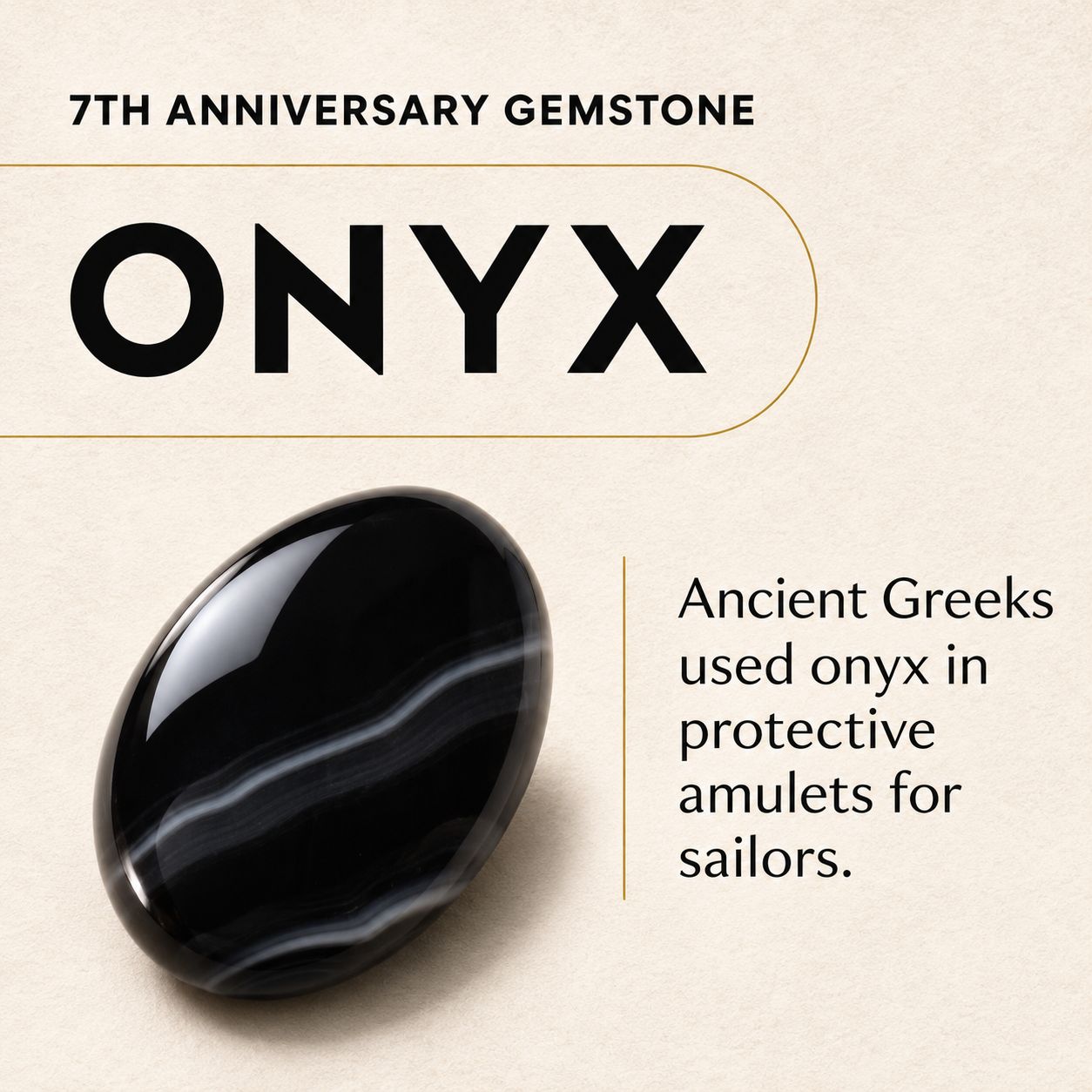
- 7th: onyx or yellow sapphire. Onyx is on most lists; one gem-education list gives yellow sapphire. Onyx is my pick for a piece worn daily, since it handles everyday wear well. Yellow sapphire is also a durable choice if your partner hates black.
- 9th: lapis lazuli, morganite or amethyst. Lapis lazuli is on most lists, morganite on one gem-education list, amethyst on some shop lists. I’d stick with lapis lazuli. Amethyst already has the 6th, so it’s the one to skip here.
- 15th: ruby or rhodolite garnet. Ruby is on nearly every list; one jeweler list and one shop list give rhodolite garnet. Ruby is the easy pick, with excellent toughness for daily wear. Rhodolite garnet makes sense only if you’ve already given a ruby at another anniversary.
The 48th and 49th Anniversaries
The lists mostly skip both years. Only one list I compared names them, opal for the 48th and amethyst for the 49th, and both are marked as variants that repeat earlier years (opal is the 14th, amethyst the 6th).
Every year between 26 and 59 that isn’t a multiple of five looks the same: most lists skip it, and the few that fill some of those years mostly reuse earlier stones.
I’d go back to the nearest milestone stone, or to a stone that already means something to you two. A sapphire at 46 that nods to the 45th says more than a stone a single list picked.
The 60th Anniversary and Beyond
Diamond is the 60th anniversary stone on nearly every list I compared that goes that far, and the 60th is often called the Diamond Jubilee. One shop list gives star ruby instead.
After 60, the lists thin out fast:
- 65th: sapphire or blue star sapphire on some lists, blue spinel on one.
- 70th: platinum on some lists, smoky quartz on one.
- 75th: diamond, the one later year the lists agree on.
- 80th and later: the lists vary, and ruby, diamond and pearl all appear.
If you’re shopping for a 75th, diamond is the safe call. For the others, pick the option your partner would actually wear.
What Tradition Says Each Stone Means
These meanings are traditions and legends, not properties of the stones. They’re still fun to put on a card, and some jewelers, like Drunk Angel, design whole collections around the meaning each stone is said to carry.
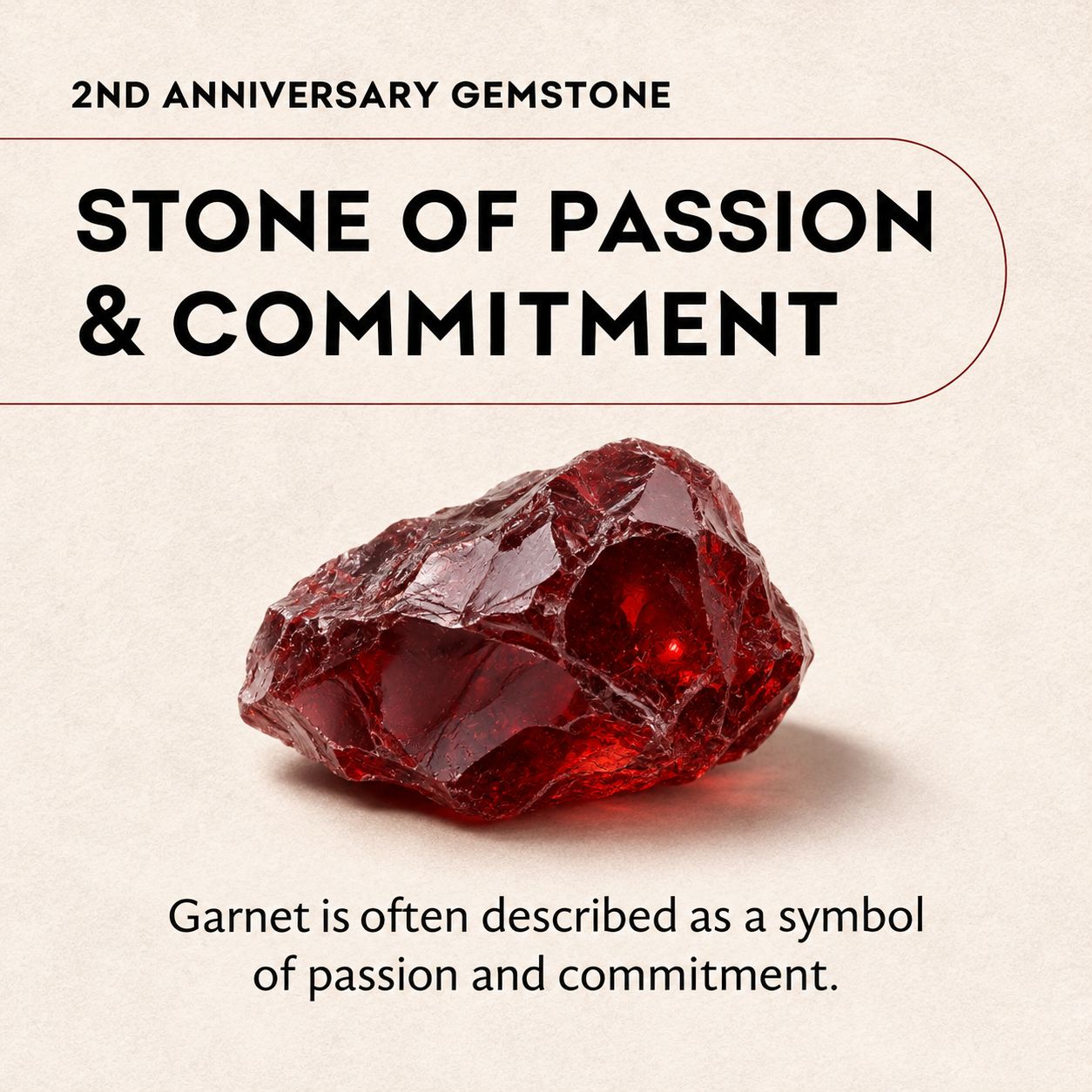
- Garnet (2nd): often described as a stone of passion and commitment.
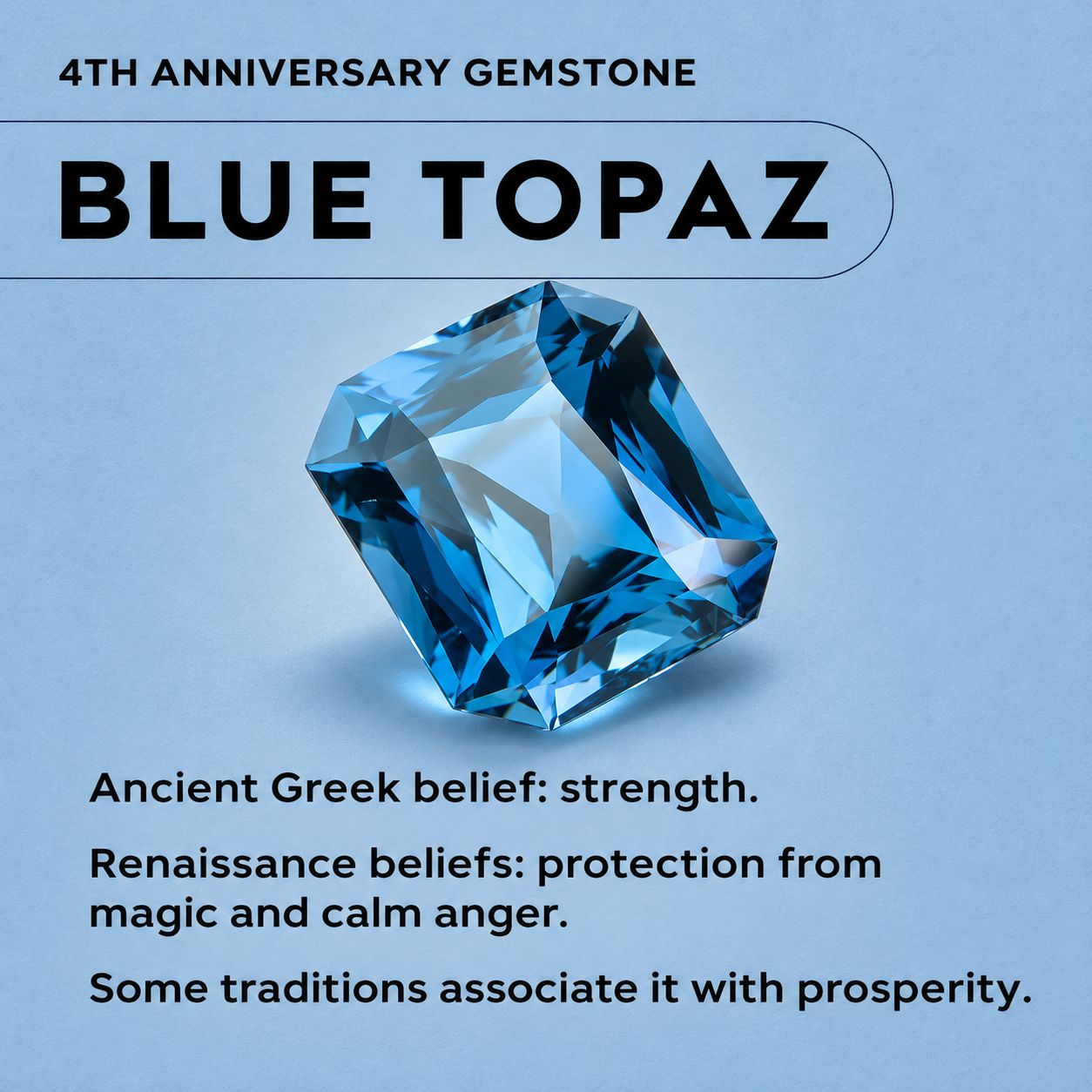
- Blue topaz (4th): the ancient Greeks believed topaz gave strength. In Renaissance Europe, people thought it could thwart magic and calm anger, and some believe it encourages prosperity.
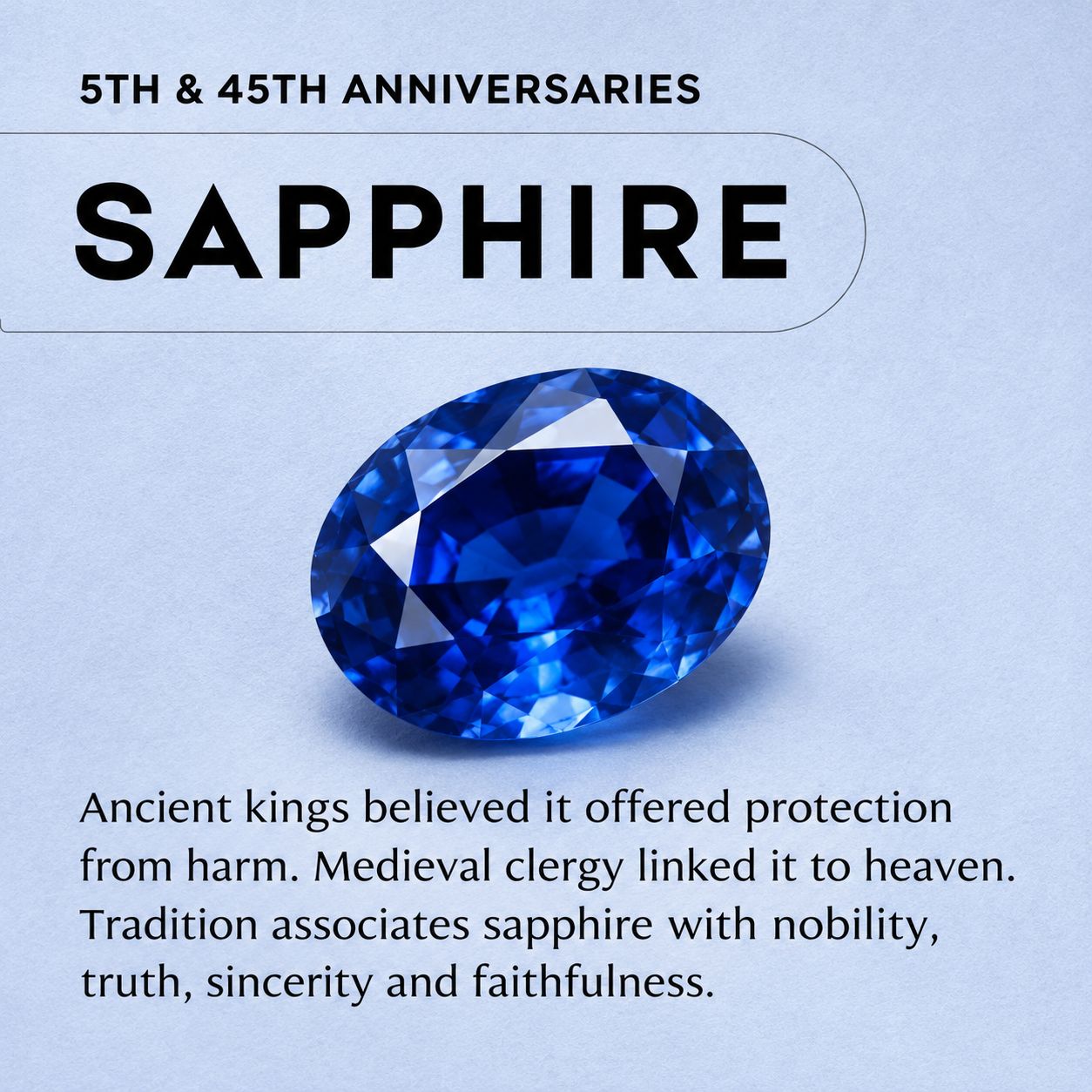
- Sapphire (5th, 45th): ancient kings believed sapphire protected them from harm, and medieval clergy linked it to heaven. Tradition ties it to nobility, truth, sincerity and faithfulness.
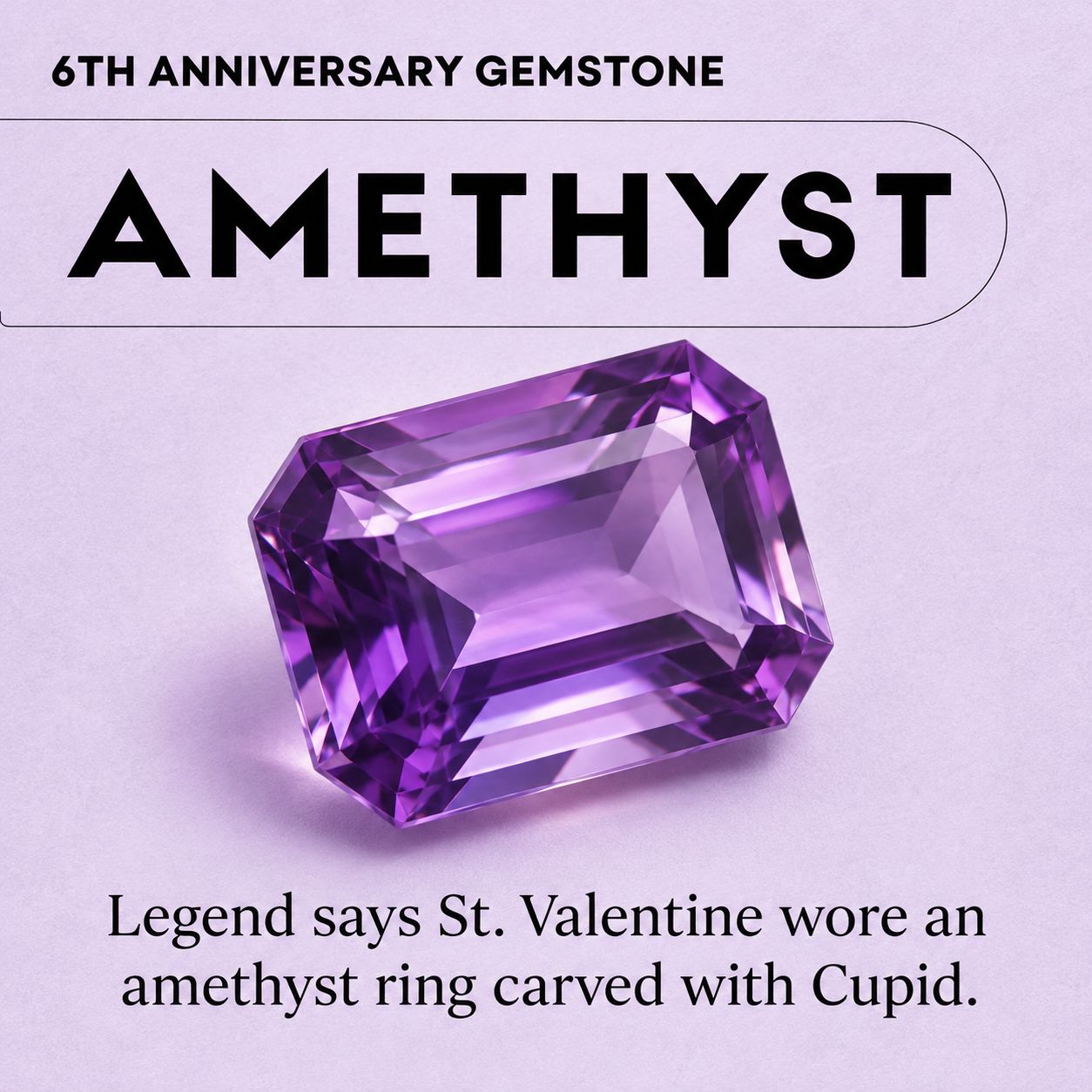
- Amethyst (6th): St. Valentine supposedly wore an amethyst ring carved with Cupid, which is about as on-brand as a stone gets.
- Onyx (7th): the ancient Greeks used onyx in amulets meant to protect sailors.
- Turquoise (11th): its colors are said to stand for a prosperous and healthy future. It’s also one of the first gems people wore as jewelry, around 4,000 BCE.
- Jade (12th): jade has been traded under the name “stone of heaven,” and jadeite has long been a good-luck symbol in the Far East.
- Opal (14th): the Romans believed opal stood for love and hope. Bedouins believed it fell from the sky during thunderstorms.
- Ruby (15th, 40th): in Sanskrit, ruby is “ratnaraj,” the king of precious stones. Ancient people believed a fire burned inside it.
- Aquamarine (19th): legend says it brings happiness to a marriage and calms stormy waters. The name means “seawater” in Latin.
- Emerald (20th, 35th, 55th): emerald’s green is often linked to springtime and renewal.
- Iolite (21st): the Vikings reputedly used iolite to find the sun.
- Imperial topaz (23rd): legend says topaz worn above the heart brought long life, beauty and intelligence. In 19th-century Russia, this color was reportedly reserved for the royal family.
- Tanzanite (24th): a newcomer. It comes from one place on Earth, northern Tanzania, and was found in 1967.
- Alexandrite (12th or 55th on some lists): no lore to report, but the color change gives you something to talk about at dinner.
- Diamond (10th, 60th): the 60th is often called the Diamond Jubilee, and diamond’s hardness is often linked to a marriage that has lasted.
Which Stones Can Handle Daily Wear
This matters most if the gift is a ring someone will wear while cooking, gardening and typing.
Three things decide how a stone holds up:
- Hardness is resistance to scratches. It’s measured on the Mohs scale, from 1 to 10.
- Toughness is resistance to chips and cracks. A hard stone isn’t always a tough one.
- Stability is resistance to heat, light and chemicals.
Fine for an Everyday Ring
Sapphire is my pick for a ring that never comes off. It’s 9 on the Mohs scale with excellent toughness, which makes it one of the most durable gems there is. Ruby is the same mineral in red, so the same goes for the 15th and 40th.
- Sapphire and ruby: 9 on the Mohs scale, excellent toughness.
- Diamond: 10, the top of the Mohs scale. Hard isn’t unbreakable, though: a diamond can split from a hard knock against a counter, so don’t treat it as indestructible.
- Jade: very tough. Both jadeite and nephrite resist chips better than sapphire and ruby.
- Onyx: 7, with good toughness. Fine for everyday wear.
Wearable With Some Care
These stones are reasonably hard, with one weakness worth planning around. Blue topaz is the one I’d happily give as a ring for the 4th. The habit to skip is leaving any of these on a sunny windowsill.
- Blue topaz and imperial topaz: 8 on the Mohs scale.
- Amethyst and citrine: both are quartz, 7 on the Mohs scale.
Topaz, amethyst and citrine can all fade after long exposure to light. Store them in a jewelry box, not in the sun.
Better as Earrings or a Pendant
These stones are beautiful, but a ring takes knocks that earrings and pendants mostly avoid. Pearl earrings for the 3rd or 30th are my favorite move in this group. An opal ring for daily wear is the one I’d talk you out of.
- Opal: not a tough stone. Sudden temperature changes can damage it, and it can crack in dry air or heat.
- Tanzanite: not tough either, and sudden temperature changes can damage it.
- Iolite: sudden temperature changes can damage it too.
- Pearl: hurt by heat, chlorine, perfume and makeup. The rule is pearls on last, off first.
- Turquoise: soaks up oils and liquids, so take it off before lotion or dishwater.
- Emerald: not tough to begin with, and often filled. Keep it away from ultrasonic cleaners and solvents.
Any of these can still be a ring for special occasions. Just don’t make it the one that goes to the gym.
For the stones I haven’t covered here (garnet, tourmaline, lapis lazuli, peridot, aquamarine, spinel, alexandrite, cat’s-eye chrysoberyl, carnelian and the rest), ask the jeweler two things: how well that stone holds up to daily wear, and whether it has been treated.
Ask About Treatments Before You Buy
Treated or lab-made doesn’t mean bad. It means you should know what you’re buying and how to care for it. A few anniversary stones are treated more often than you’d guess:
- Blue topaz (4th): natural blue topaz is very rare. Almost all blue topaz in jewelry is colorless topaz that has been irradiated to turn it blue.
- Citrine (13th): natural citrine is rare too. Most citrine sold is amethyst that has been heated, which is worth knowing if you’re shopping for the 13th.
- Onyx (7th): “black onyx” is often dyed chalcedony.
- Spinel (22nd): many spinels are lab-made, and the seller should tell you so.
- Emerald (20th, 35th, 55th): emeralds are often filled with oil or resin, which changes how you clean them.
One bonus for the 21st: iolite is usually untreated, and it looks a lot like tanzanite for less money. If tanzanite feels out of reach at 24, iolite three years earlier is a sly way to get the look.
Whatever stone you choose, ask the question, write the card, and let the tradition do half the work. The other half is that you remembered which year it is.