It fails in predictable ways, though. Glossy leaves flare under a camera flash. Light pots tip over when someone backs into them mid-conversation. And some venues turn faux trees away at the door over fire certificates nobody thought to ask for.
Here’s where artificial trees work in wedding decor, and how to set them up so they photograph like the real thing.
Frame Your Ceremony Altar With Statement Trees
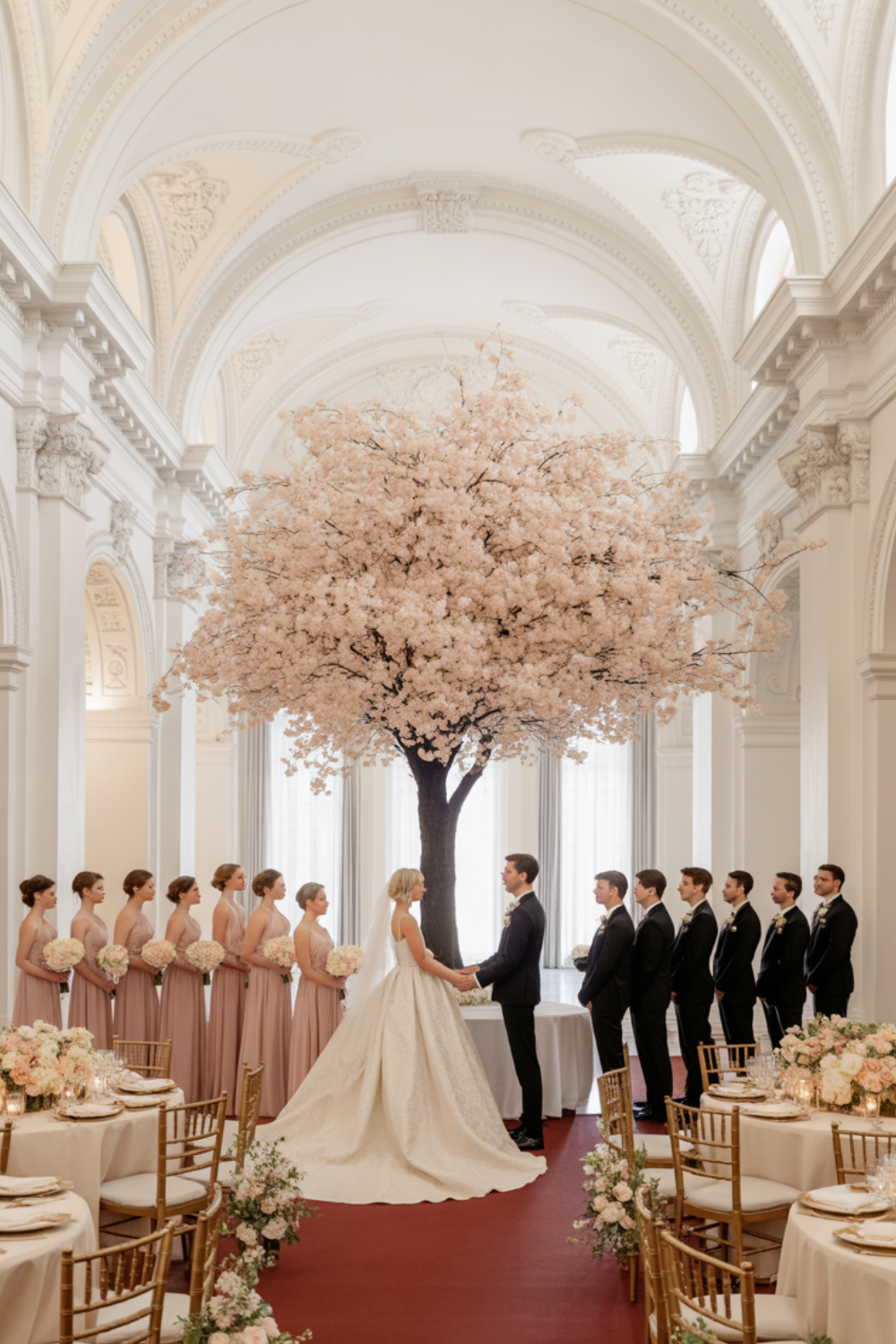
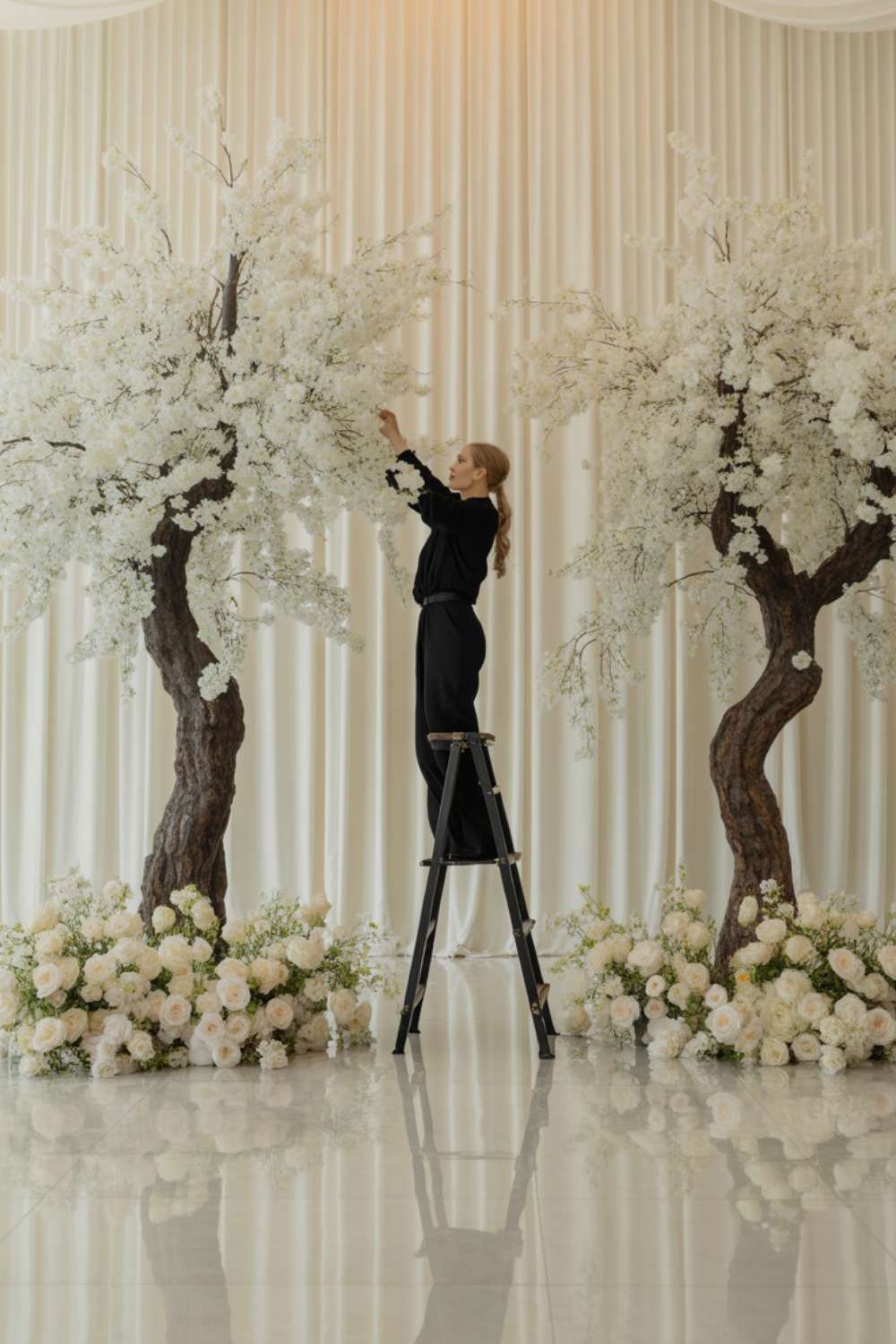
Two matched trees at the end of the aisle give you a full altar frame that holds its shape through a July afternoon and doesn’t droop by the time the photos start.
Species sets the mood more than size does. Cherry blossom drops a soft canopy overhead, which is the one people photograph from underneath. Olive reads neutral in almost any room, and full green ficus is the one to pick when the rest of your decor is already loud.
For layout, a matching pair reads formal and symmetrical. If that feels stiff, go asymmetrical instead: one tree on one side, a low floral cluster on the other.
Then fix the bases, because that’s where the illusion usually breaks. Rental plastic pots look like rental plastic pots in every close-up. Drop them into ceramic planters or square wooden boxes before anyone lifts a camera. And measure your venue’s ceiling height before you order, not after.
Build a Photo Spot With Real Depth
A flat backdrop looks flat in every single frame. The fix is layering, and trees work for it because they have volume that a fabric panel doesn’t.
Cascading wisteria and cherry blossom both work here, wisteria for sweeping texture and blossom for a soft color pop that flatters everyone standing under it.
Build it in planes. Trees at the back, sheer drapes softening the gaps, low florals or candles in the foreground, and the couple standing in between. A photographer shooting into that has something to focus through.
Lighting is the part people get wrong. Direct flash bounces off synthetic leaves, and suddenly everyone can tell. Put warm uplights below or behind the foliage so the light rakes across the texture instead of hitting it head on.
Last thing: tuck the cords and zip ties, and keep the whole setup out of the main walkway.
Turn the Escort Card Table Into an Entrance Moment
The escort card table is one of the few spots where guests stand still, at close range, with time to look at things. It usually gets a folding table and a blank wall.
Flanking your seating chart or welcome sign with a matched pair of trees fixes that in about ten minutes of setup. Tall leafy greenery keeps it neutral, olive looks quieter and more expensive, and flowering blossom is what guests react to on the way in.
Guests get within a foot of these, so collar the pots thickly with real moss or fresh greenery. At that distance people notice the base long before they question the leaves. Weight those bases too, and pull them back from the walkway, because kids and tipsy uncles will find them.
Line a Walkway for a Tree Tunnel
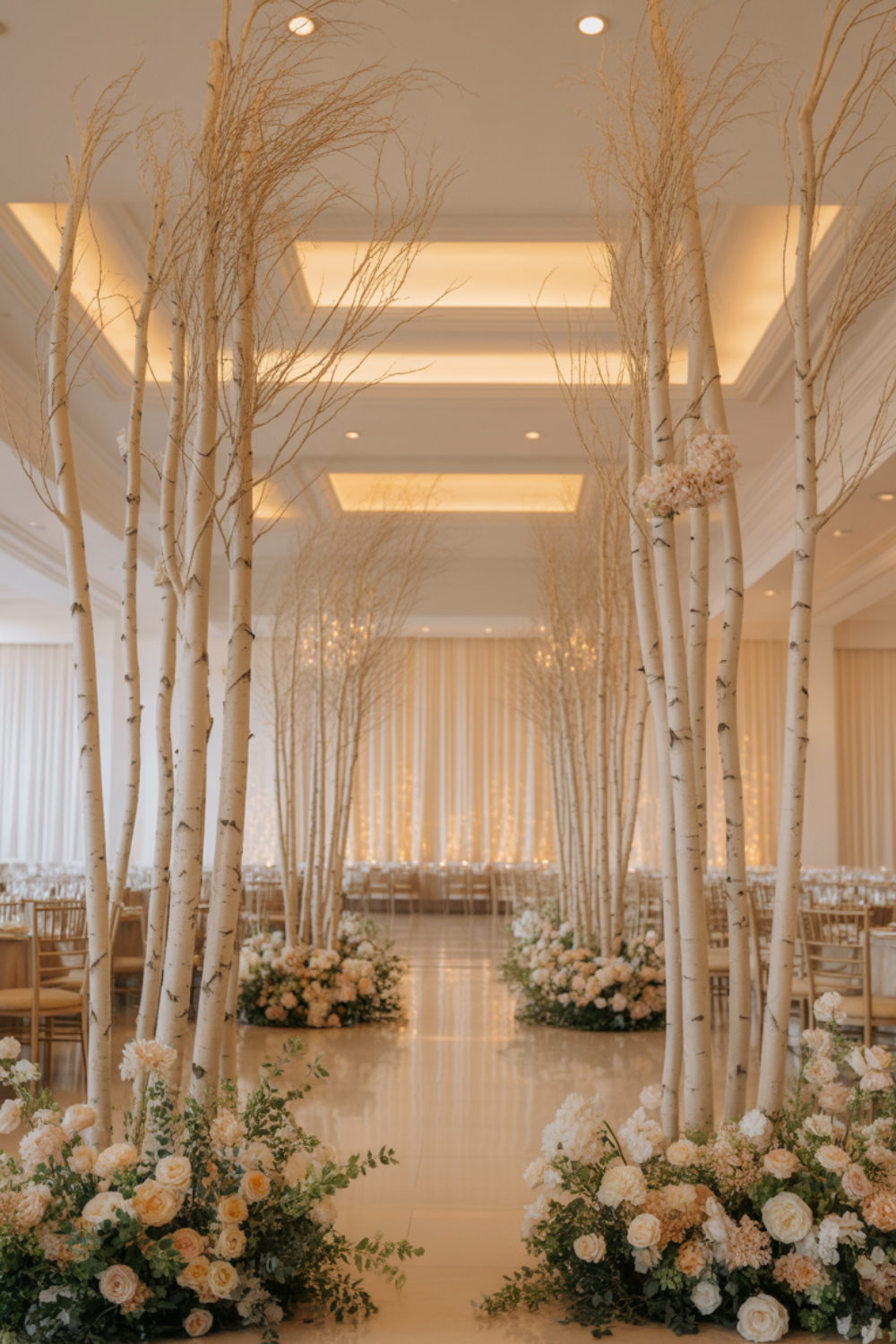
Lining an aisle, entrance, or cocktail hour path with trees turns a corridor into something people walk through slowly. Done badly, it turns it into a garden center obstacle course.
What separates them is mostly discipline about repetition and spacing.
- Repeat one species the whole way down. Mixing varieties looks busy fast.
- Space matched pairs four to six feet apart so the canopy reads continuous rather than spotty.
- Light from the ground with warm uplights, lanterns, or pillar candles.
Leave more shoulder room than you think you need. A gown with any real volume, plus catering staff moving in the other direction, needs clearance that looks almost too generous when the room is empty.
Go Glam With Metallic or Pre-Lit Trees
Some faux trees aren’t imitating anything. The metallic, all-white, and pre-lit end of the commercial-grade artificial tree market drops the realism entirely, which is why those read as deliberate styling rather than a cheap swap for fresh greenery.
They suit black-tie ballrooms, evening receptions, and winter weddings. Put them behind the sweetheart table for a glowing backdrop, along the edges of the dance floor to define the space, or in one spot as the photo moment.
Keep the surrounding palette simple so the tree is the thing people look at. Choose warm white bulbs over cool blue LEDs, which go harsh and slightly clinical in photos.
Glam trees look wrong in a rustic barn or a boho garden setup, so skip them entirely if that’s your look. And find out where the power outlets are before you commit to anything pre-lit, unless you want extension cords running across a dance floor.
Frame the Sweetheart Table Without Crowding Your Photos
Stray branches sprouting from a groom’s ear is a real and common sweetheart table result. It comes from setting trees too close and too narrow.
Set them directly behind the table and slightly wider than the chair backs. That frames your silhouette without putting foliage next to your faces or blocking the light coming at you.
Olive suits a Mediterranean feel and full leafy green keeps it cleaner. Soft blossom is the one to pick if you want romance sitting behind you in every reception shot.
Hide the pots with a low floral meadow or a simple linen wrap, keep heavy canopies away from open flames, and leave room for servers to pass behind your chairs.
Zone Large Rooms and Awkward Corners
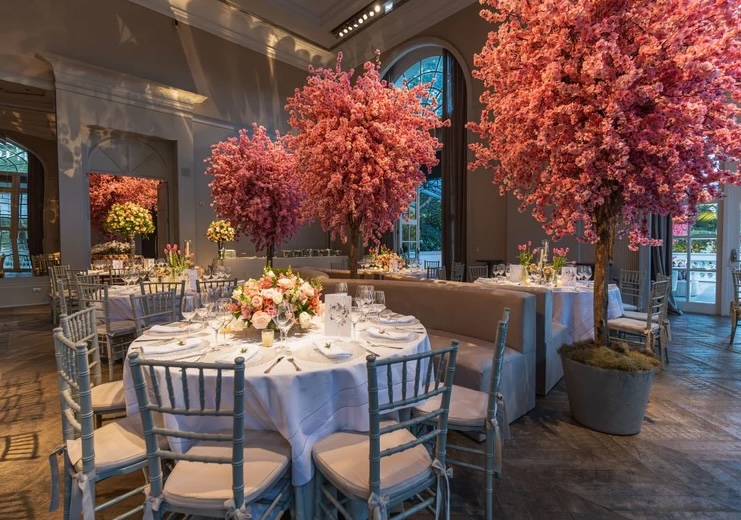
A cavernous reception room with tables scattered through it feels like a hall, not a party. Trees are the quickest way to break the floor plan into rooms without building anything.
They work hardest around lounge corners and bar edges, where they make a cocktail area feel enclosed, along the dance floor perimeter to contain the party, and at the transitions between dining and cocktail space.
Tall ficus and full greenery stay neutral, palms turn the room tropical whether that was the plan or not, and mixed leafy foliage gives you a looser garden feel.
Whichever you choose, repeat the same planter style and the same foliage tone in every zone. Repetition is the difference between a layout that looks designed and one that looks filled in. Before anything gets placed, walk the floor plan against the venue’s fire exits and vendor access routes.
Build Tree Centerpieces Guests Can See Over
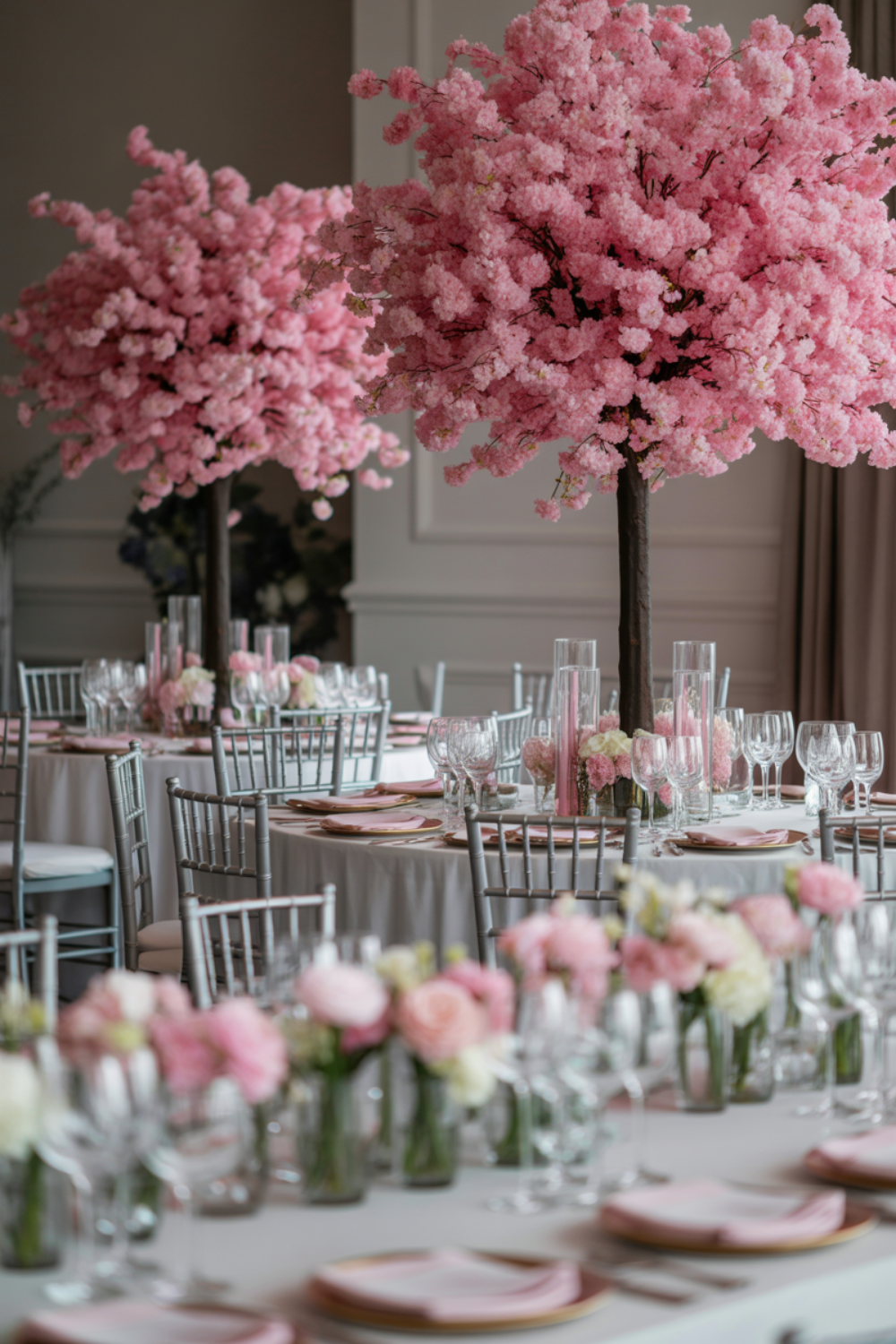
Centerpieces that block sightlines turn every table into two separate conversations. Tree centerpieces are especially good at this if you pick the wrong shape.
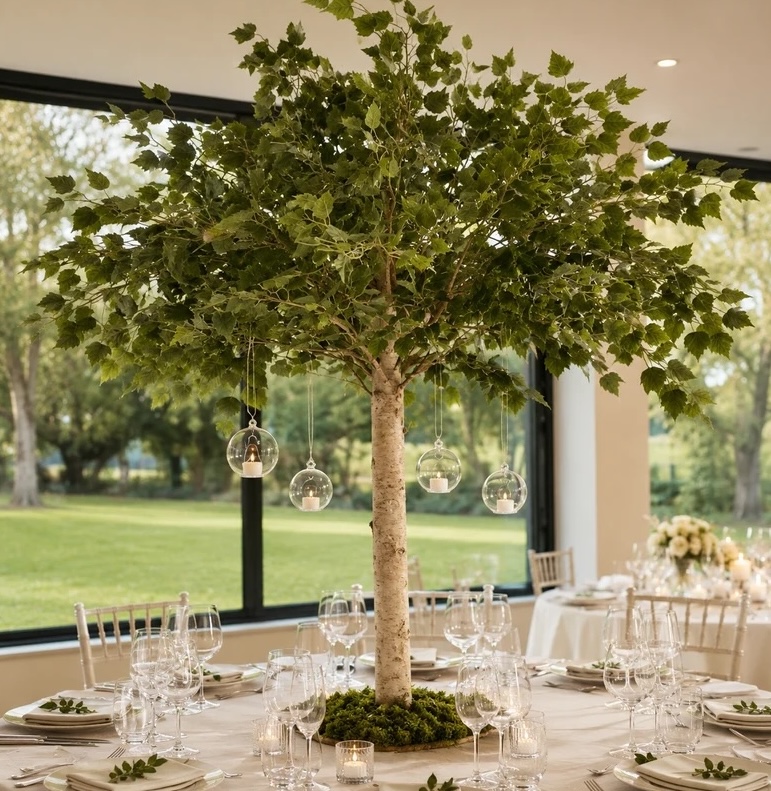
Short potted mini trees avoid it by staying below the sightline, which suits intimate rounds and long narrow banquet tables. Tall statement trees avoid it from above, with the canopy high on a slim trunk and florals anchoring the base, so guests look straight through the gap in the middle.
Either way, keep nothing dense between roughly two and five feet off the table. That band is where conversation happens.
Moss over the base pots, votives or pillars around the trunk, and a few fresh stems tucked into the faux branches will hold up under a close-up lens. If you want more shapes to work from, our round table centerpiece ideas cover the arrangements that sit well at that height.
Set Up a Wish Tree Guest Book
A wish tree gives guests something to do and gives you a guest book that ends up on a wall instead of in a drawer. Manzanita branches are the usual pick because they’re sculptural and sturdy enough to hold weighted tags. Bare-branch trees work too, with more open space for hanging.
Put it near cocktail hour where the foot traffic is. Set out pre-cut cardstock tags with ribbons already attached, pens that dry fast, and a sign telling people what to write.
Keep tags and ribbons inside your color palette, and add a small tray to catch spare cards, ribbon offcuts, and pen caps so the table still looks good at 10pm. We’ve got more of these in our roundup of wedding guest book trees if you want to see how other couples have set them up.
Weight the base more than seems necessary. Guests lean on wish trees, hang things off them, and occasionally pull.
Take Faux Greenery Outdoors Without a Wind Disaster
Outdoors, faux trees give you greenery that survives the day without a watering plan. Wind is the problem. A gust can put a seven foot tree on the ground, or on a guest.
Put them somewhere sheltered: courtyards, covered patios, tents, walled breezeways. Before you commit, confirm the trees are outdoor rated with UV protection so the leaves don’t fade or bleed, and ask your venue coordinator how the wind usually behaves on that site.
Anchor every tree on a wide heavy base, stack sandbags over it, then hide the ballast under a greenery collar or mulch. Agree a weather pivot with your setup team ahead of time so nobody’s improvising in a rising breeze while guests arrive.
One more thing worth doing at your site walkthrough: look at where the afternoon sun lands. Glossy leaves in direct sun can look obviously plastic in exactly the hour you’re taking portraits.
Pair Trees With an Arch or Drape Panel
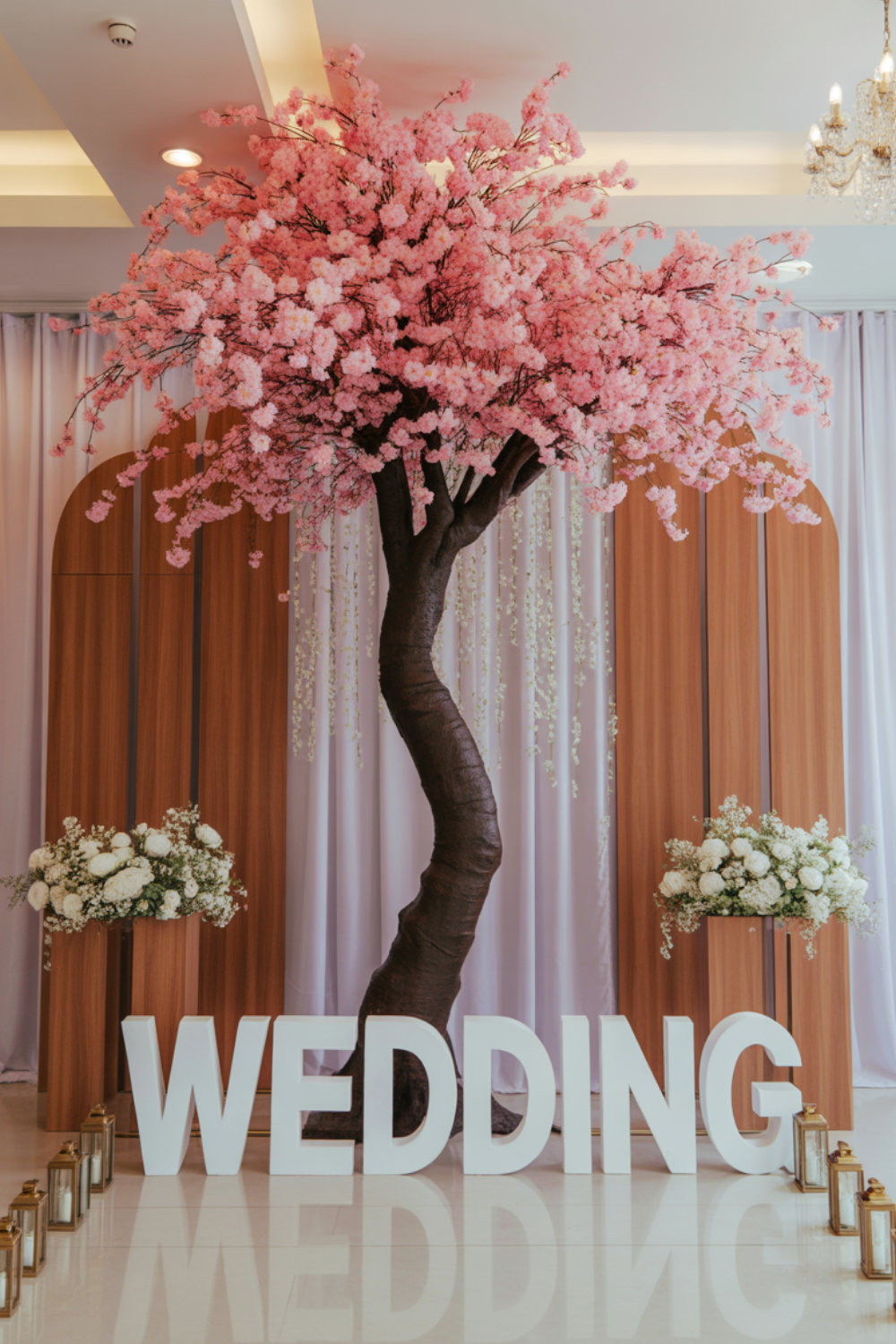
Sometimes trees on their own aren’t enough for a ceremony setup. In a wide room or against a busy wall, a pair of trees leaves a gap in the middle where the focal point should be, and the whole altar looks unfinished in photos.
Adding a structure fixes it. The trees give you width and depth, the arch or drape holds the center.
Two combinations worth trying: a clean metal or wooden arch flanked by trees and softened with light florals, or fabric drape panels hung behind the greenery for height and contrast. Our roundup of unique ceremony backdrops has more options if you’re still deciding what goes in the middle.
Don’t stack everything at once. A heavy arch plus large trees plus dense florals in a tight space reads as clutter, not abundance.
What to Sort Out Before You Buy or Rent
The styling is the easy part. What catches couples out is the logistics, so work through these before you sign anything.
Run a Realism Check Before You Commit
Look at a sample in person if you can, or ask for detailed close-up photos. Four things tell you whether a tree will survive a camera.
- Matte or semi-matte leaves. Glossy finishes throw back the flash.
- Asymmetrical branching. Evenly spaced branches look manufactured from across a room.
- Sculpted bark with tonal variation, not smooth painted resin.
- A factory pot that drops cleanly inside a decorative planter.
Decide Whether to Rent or Buy
Buying is a bigger number than most couples expect. At specialist suppliers, altar-height trees in the eight to ten foot range mostly sit between $1,100 and $3,500 each, with smaller floor trees starting around $400 and large fiberglass-trunk blossom trees running well past $8,000. That means a matched pair is a four-figure line item before you’ve bought a single planter.
For one wedding, renting is almost always the better call. Buying makes sense if you’re a venue owner or planner reusing them across a season, or if you’ve genuinely got a resale plan and somewhere to store two enormous boxes until it happens.
Plan the Delivery and the Setup Time
These arrive as bulky cargo, and venues have doorways. Measure doorway widths, ceiling heights, and freight elevator dimensions at least two weeks out.
Budget 30 to 45 minutes per tree for unboxing, assembly, and fluffing the branches, which takes longer than anyone expects. If you’re moving them in a personal vehicle, confirm the trunks break down into sections first.
Get the Fire Paperwork in Writing
Plenty of indoor venues and local fire marshals require certified NFPA 701 flame-retardant documentation before synthetic decor comes through the door. A product page saying “fire resistant” is not documentation and won’t pass an inspection.
Ask your supplier or rental company for the actual test certificates early, then send them to your venue manager. This is the one that ruins setup day if you leave it late.
Frequently Asked Questions
A few things couples ask us before they book faux greenery.
Do Artificial Trees Look Tacky in Wedding Photos?
Not if you choose well. Cheap synthetic leaves bounce the flash straight back and the illusion goes immediately. Stick to matte foliage, dress the bases with fresh moss or potted ferns, and light with warm angled uplights rather than direct flash. The realism check above covers what to look for before you commit.
What Do Artificial Wedding Trees Cost?
To buy from a specialist supplier, most altar-height trees land somewhere between $1,100 and $3,500 each, with small floor trees from about $400 and oversized blossom trees on fiberglass trunks going past $8,000. Rental costs less per event and skips the storage problem, which is why it suits most couples planning a single wedding.
Is It Better to Rent or Buy Artificial Wedding Trees?
For a single wedding, renting wins on almost every count. Commercial-grade faux trees cost real money to buy, need a van to move, and take up serious space in a garage afterwards. Buying makes sense if you’re a venue owner or planner using them across many events, or if you’ve already lined up a buyer for the week after the wedding.
How Do You Keep Tall Faux Trees From Tipping Over?
Drop the factory pot into a heavy wide-bottom planter and pack the bottom with hidden ballast: sandbags, brick pavers, or barbell plates. Then give every tree a firm shoulder bump during setup. If a top-heavy canopy sways, add another ten pounds and test again. Do this properly for anything near the bar or the dance floor.
Can Artificial Trees Be Used Outdoors?
Yes, as long as they’re outdoor rated and UV resistant so the foliage doesn’t fade or take on a blue cast in bright light. Wind is the real risk, so keep them in sheltered spots like covered patios or walled courtyards and weight every base. Check the afternoon light during your site walkthrough too, since glossy leaves in direct sun are the ones guests squint at.
Will My Venue Allow Artificial Greenery Under Fire Rules?
You have to ask, every time. Many indoor venues need certified NFPA 701 flame-retardant paperwork before synthetic decor is allowed through the door, and marketing copy claiming something is “fire resistant” won’t satisfy an inspection. Request the test certificates from your supplier early, then pass them to your venue manager well before setup day.