A Memorable Father-Of-The Bride Speech: Tips, Tricks, And Examples
Standing up in front of a room full of people to toast your daughter? That’s not public speaking—it’s an emotional ambush with a microphone. You love her more than anything, and somehow you’re supposed to compress that into five minutes without crying, rambling, or accidentally referencing that time she crashed your car.
Here’s the good news: you don’t need to be perfect. You need to be short, personal, and heartfelt. That’s it. We’ve stripped away the fluff to give you a plug-and-play structure, story prompts that don’t sound cheesy, and essential delivery tips that’ll keep you from going viral for the wrong reasons.
Let’s start with the one simple structure every great speech follows.
1. The 6-Step Plug-and-Play Wedding Toast Template
The real terror of public speaking isn’t forgetting a line—it’s accidentally rambling for eight minutes while your daughter makes “wrap it up” eyes at you. You need clear guardrails.
The best father of the bride speech structure is simple and effective. This template keeps you under four minutes, lands with everyone from college friends to reserved relatives, and actively prevents rambling.
The Standard Speech Structure
This is your invisible framework. You’re filling these six steps with your personality and stories.
- Identity Check: Introduce yourself and your relationship to the bride.
- Welcome & Thanks: Welcome guests and deliver quick thank-yous (the in-laws, especially).
- Absent Loved Ones: Briefly acknowledge anyone missed (optional; coordinate with the couple).
- The Bride: Share 1-2 short anecdotes that reveal a key trait (kindness, determination).
- The Partner: Welcome them and acknowledge the joining of families.
- Wishes & Toast: Offer short advice or wishes, then conclude with the official toast.
Quick Checklist for the Nervous Speaker
This isn’t a script—it’s your mental recovery sequence for when you blank. Keep this front-of-mind:
- Who I Am
- Thank You
- Bride’s Best Trait (Story)
- Welcome Partner
- Advice + Toast
Crucial Don’ts and a Pro-Tip
First, the Don’t: Never read this structure as a checklist. Your delivery must feel conversational.
Now, the Pro-Tip: If you fear freezing up, write the bolded section headers (like “Welcome Partner”) onto cue cards. If you lose your place, glance down; the header instantly recovers your thought, preventing awkward repetition.
2. Nailing the Opener: Four Patterns to Reduce Public Speaking Panic
The blank mind at the podium is worse than the blank page. Your goal in the first 15 seconds is simple: land a small laugh or a warm nod. This micro-success proves you’re connected to the room and instantly drops your anxiety by half.
The Four Best Opening Styles
Skip “Wow, look at all of you.” Try one of these reliable patterns instead:
1. Light Self-Deprecating Joke
Focus the joke entirely on your nerves or your minimal effort—never on the couple or guests.
Example: “For those of you who don’t know me, I’m [Bride’s Name]’s father, [Your Name]. This is the second hardest thing I’ve ever had to do—the first was learning how to properly set up a wedding website.”
2. Simple Gratitude Opener
The safest, most sincere path. If you dislike being the center of attention, lead immediately with genuine thanks.
Example: “I’m incredibly grateful to everyone who has traveled here today. Standing here, I’m overwhelmed by the sheer amount of love and support for [Couple’s Names].”
3. Micro-Story Opener
Skip the preamble and jump straight into a quick memory that connects the bride’s past to her present partner. Keep it under two sentences.
Example: “I remember [Bride] was five, wearing my oversized boots, telling me she was going to marry a prince. [Partner’s Name], you are definitely the upgrade.”
4. Emotion-First Opener
Be honest about the weight of the moment. This lands beautifully if you’re naturally sentimental.
Example: “I knew I’d have a hard time getting through this without tearing up, so I wrote it all down. But looking out at the two of you tonight, I realize I don’t need the notes—I just need to tell you how proud I am.”
The Rule of Funny and Seamless Transitions
If you’re not naturally funny, do not cosplay a comedian. A forced joke is painful; stick firmly to gratitude or the micro-story instead.
Once you deliver your opener, use a quick bridge sentence to move into the main welcomes: “We are all so happy you could join us for this incredible celebration.”
Finally, skip the major clichés. Avoid opening with lines like “I’m not losing a daughter, I’m gaining a son.” If you must use that sentiment, rewrite it completely in your unique voice—generic is boring.
3. The Anecdote Builder: How to Tell a Story, Not a History Lesson
Stop sweating the “Bride” section. Your goal isn’t to deliver a biography; that makes guests check their watches. The best wedding toasts use a tiny story—a moment lasting maybe 30 seconds—to reveal one key trait that defines her.
You need to show who she is, not prove she was always perfect.
The 3-Part Story Structure That Actually Works
Turn a vague memory into a compelling, short anecdote:
- Scene: Where and when did this happen? Use just one vivid detail to ground the listener.
- Turn: What changed or surprised you? This is the emotional arc: the unexpected choice she made.
- Takeaway: What character trait does this reveal? Bridge this quality directly to her life today.
Quick Editing Rule: If your story needs three lines of backstory before it gets funny, it’s not ready. Ditch it and pick a cleaner memory.
Fast Story Material Generators
Need material now? Skip the vague childhood archives. Use these prompts:
- The first time she… was undeniably brave, shockingly stubborn, or truly hilarious in a way no one expected.
- A small moment that sums her up… Focus on a mundane event where her core personality shone through.
- A moment I realized she’d be okay without me… This is the sweet spot: pride mixed with a little sentimental loss.
Example: Using the Builder to Show Determination
Don’t just say she’s determined; show it:
- Scene: She was 12, standing in the backyard in the pouring rain, trying to fix the old bicycle chain. Her hands were black and dripping wet.
- Turn: I told her to come inside, but she looked up, shook her head, and said, “It’s not broken, Dad. I just haven’t finished fixing it yet.”
- Takeaway: That fierce determination made her successful in her career, and it’s why I’m so confident in her marriage to [Partner’s Name].
This method delivers a genuine compliment wrapped in a story. Use this moment to transition: highlight her quality, then show how her partner supports and matches that brilliant trait.
4. The Three-Bucket Rule for Short, Punchy Thank-Yous
You feel obligated to thank everyone who helped, traveled, or showed up. Etiquette requires gratitude, but if you start naming thirty individuals, the room goes dead and dinner gets cold.
Your thank-yous are necessary, but they are not the main event.
Stop the Roll Call, Use the Buckets
The Three-Bucket System ensures everyone feels acknowledged without killing the vibe. You’re thanking groups, not individuals.
Bucket 1: The Guests. Start with a one-sentence welcome, specifically acknowledging travelers.
- Sample: “To all of you who made the trip, especially those who flew in from [State/Country], thank you. We are thrilled you are here to celebrate [Couple’s Names].”
Bucket 2: Key Financial/Logistical Contributors. Limit this to immediate family and essential hosts (parents, in-laws).
- Sample: “A huge thank you to [Partner’s] parents, [Names], for their incredible kindness and help welcoming our daughter into their family.”
Bucket 3: The Wedding Party. Deliver a single, enthusiastic group shout-out.
- Sample: “Finally, a massive thank you to the brilliant wedding party. You have been the best kind of chaos and support.”
Timing: When to Drop the Gratitude
The safest and most efficient placement is right after your opener.
If you’re a highly emotional speaker, however, consider placing the thank-yous later—after you’ve told the story about the bride and recovered your composure. If you choke up, at least it’s over something personal, not over forgetting the caterer.
Remember the common trap: The 30-name list. If you start naming every cousin and vendor, you lose the room entirely.
Now, the actual reason we’re all here… my daughter.
5. Welcoming the Partner: Ditch the Cringe, Embrace the Sincerity
The shift from talking about your child to welcoming their partner is the most delicate pivot in your speech. Avoid outdated clichés—you’re welcoming a new family member, not issuing an ownership transfer certificate.
The Three Pillars of a Modern Welcome
You don’t need a decades-long history with the partner. Hit these three emotional angles:
- The First Positive Impression: Focus on a specific trait you immediately noticed. Did they make your child laugh uncontrollably the first time you met them?
- What You’ve Observed: Acknowledge the quality of their relationship. Mention how they treat each other when they think no one is watching.
- What You’re Excited to Share: Frame this as a family expansion. What shared tradition or interest are you genuinely excited to bring them into?
Swap Out the Clichéd Phrases
| Instead of Saying… | Try This |
|---|---|
| “You’re gaining a son/daughter.” | “We are lucky to be expanding the family with you in it.” |
| “Take care of her/him.” | “Keep choosing each other—especially on the hard days.” |
| “I approve of you.” | “It’s been wonderful watching how you truly elevate [Bride/Partner’s Name].” |
A Quick Note on Teasing
If you include a light joke, keep it gentle and focused on a mutually shared quality (like their tendency to binge-watch terrible reality TV). Never use a joke that suggests the partner isn’t good enough. Tease only when the joke signals warmth and inclusion.
6. Practical Scripts for Blended Families and Complex Dynamics
The modern family tree often looks more like complicated bonsai than a sturdy oak. Your speech is not the time to mediate grudges or rewrite history. Your job is simple: be respectful, keep the atmosphere light, and honor the couple.
Scripts for Complex Scenarios
Keep these moments short, genuine, and focused on inclusion.
Divorced Parents / Co-Parenting:
Acknowledge the other parent without forced warmth. Keep it brief and focused only on the shared achievement.
Try this: “I want to thank [Other Parent’s Name]. We didn’t always see eye-to-eye on the little things, but we both nailed the big thing: raising [Bride’s Name]. Thank you for your continued support.”
Stepfather Speaking:
Claim your role honestly without erasing the biological father (if present). Authenticity beats forced diplomacy.
Try this: “While I didn’t raise [Bride] from day one, I’ve had the joy of choosing them every day since [Year]. Welcome to the family, [Partner’s Name]; you are marrying a determined and loving person.”
Two Brides or Two Grooms:
Your language must be specific and celebratory. Avoid treating the union as a “special case.”
Try this: “We have never seen [Bride] happier than she is when she’s with [Partner]. We welcome our two beautiful brides/grooms into the family with open hearts.”
Absent or Deceased Loved Ones:
Acknowledge the loss gently and swiftly, then pivot immediately to the celebration. Crucially, coordinate with the couple so this acknowledgment happens once.
Try this: “We wish [Loved One’s Name] could be here to witness this joy. They are with us in spirit, and we raise our glasses to the memory of their love and laughter.”
Red-Flag Topics to Avoid
Do not use the microphone to air grievances, even subtly. You might think you’re joking, but the risk is always too high.
Strictly avoid:
- Passive-aggressive digs
- Jokes about divorce or remarriage history
- Comments suggesting the partner is replacing anyone
- Blame, financial discussions, or unsolicited advice
Short and sincerely loving beats long and complicated every time.
7. The Perfect Toast Length: Translating Minutes into Words
You’ve built the structure and polished the anecdote. Now for the crucial question: How long is too long? The moment guests start checking their phones, your speech has failed.
The 5–7 Minute Sweet Spot
The ideal range for maximum impact is 5–7 minutes. Anything over eight minutes tests the patience of a hungry crowd.
To hit that mark, your first draft should aim for 750–1,000 words. You need material to cut. Critically, remember that applause, laughter, and emotional pauses add significant time; a 750-word script rehearsed in five minutes might clock seven minutes live.
The “Cut by a Third” Editing Move
Your first draft is always too long. The most critical move is an aggressive edit pass to remove 25–30% of the material. Focus your second pass on:
- Eliminating repeated thoughts or sentiments.
- Tightening stories (cut unnecessary descriptions).
- Removing superfluous “thank yous” outside the Three-Bucket rule.
A Pacing Checklist for Controlled Delivery
| Section | Time |
|---|---|
| Opener & Welcome | 10–20 seconds |
| Thank-Yous (Buckets) | 30–45 seconds |
| The Story/Bride Section | 60–90 seconds |
| Welcoming the Partner & Toast | 40–60 seconds |
8. The Flawless Delivery: Microphone, Notes, and Nerves
You wrote the speech. Now, focus on delivery. Nerves are normal; clarity is the priority. You don’t need charisma—just be clear and genuine.
How to Read Your Notes Without Looking Like a Robot
Forget memorizing. The best speakers read their notes, but they make it look effortless.
- Go Big: Use a large font (size 18 or 20). Squinting breaks your connection with the audience.
- Mark Pauses: Use bolding for emphasis and slashes (/) to denote intentional pauses.
- Use Cue Cards: Instead of a messy sheet, use 5–7 index cards with section headers. If you lose your spot, you immediately jump back to the header.
Microphone Technique
The microphone is your lifeline; treat it like a consistent companion.
- Anchor Distance: Keep the mic 2–3 inches from your mouth. Do not drift away on punchlines—that kills the audio.
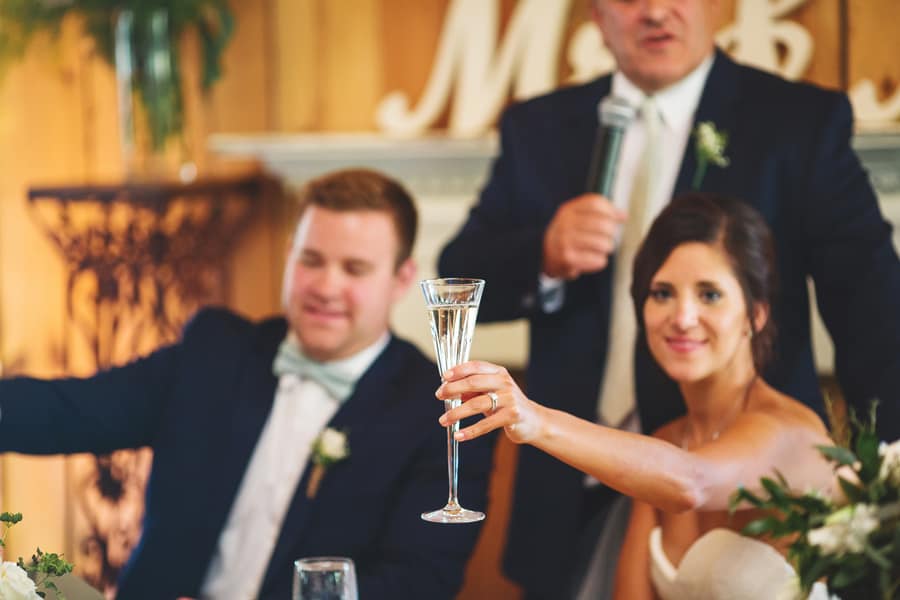
- The Toast Pause: After the main content, pause briefly before delivering the actual toast. Wait until the room quiets.
Body Language Defaults
Your body language should project calm, even if you’re panicking internally.
- Feet & Hands: Plant your feet shoulder-width apart to prevent nervous swaying. Keep one hand on the podium or notes for stability.
- Eye Contact: Look directly at your daughter and her partner during the emotional, key lines. Scan the room during thank-yous.
The Recovery Plan
If you choke up, freeze, or get teary, use this three-step recovery:
- Take a deliberate sip of water.
- Smile sincerely.
- Hold a short 3–5 second pause, then continue.
Also, manage nerves with a practical rule: One drink max before speeches. You want warm feelings, not slurred words.
9. The Final Line: Crafting the Perfect Closing Toast
Don’t let your speech fizzle at the finish line. The closing toast is the final, audible memory cue guests receive.
The 30-Second Toast Formula
- Raise Glasses: Wait for guests to prepare their drinks.
- Name the Couple: State their names clearly and together.
- Thematic Wish: Deliver your carefully chosen closing line.
- Closing Line: A simple final phrase (e.g., “To happiness,” or “To the future.”)
Trading Clichés for Virtue: 6 Toast Themes
Ditch the vague “to happiness.” Give your final wish thematic weight by choosing a virtue that actually defines the couple.
| Theme | Sample One-Liner |
|---|---|
| Adventure / Travel | “May your marriage be an endless passport, always full of new stamps and shared horizons.” |
| Home / Family | “May you always remember that the best home you build is the one you build together.” |
| Laughter / Friendship | “To the rare joy of finding your best friend in your great love—may the laughter never fade.” |
| Resilience / Overcoming | “May your roots grow deep enough that when the wind blows, you simply stand stronger together.” |
| Kindness / Partnership | “To finding the one person whose kindness you never stop relying on. Cheers to your unwavering partnership.” |
| Food / Wine (Light) | “May your life be like a great wine—rich, complex, and getting better with every vintage.” |
Warning: Never use inside jokes only three people get. This ending is for the whole room.
Optional Handoff Line: If you’re introducing the next speaker: “Please join me in raising a glass to [Couple’s Names]. Now, I’ll hand the microphone to the Best Man, [Name].”
10. Real Father of the Bride Speech Examples That Actually Nail It
Theory is great, but you want to see this in action. These real speeches demonstrate exactly what we’ve been talking about—and why the principles work.
Prepare to get educated…
BEST Father-of-the-Bride Speech. Ever. (According to the person who uploaded the Youtube video)
We love the way he includes the groom the whole way through, and his toast is perfect.
You’ll notice this guy incorporates money and religion in his speech and manages to make it not at all awkward, but fabulous. Shows how bendable the rules can be if you’re on your game…
Heartwarming Father-of-the-Bride Speech (Get Out the Hankie!)
This father offers up a funny and heartwarming speech, along with a few props that take this speech to another level.
Hilarious Father-of-the-Bride Speech That Includes the Groom’s Family
He’s included the groom’s family in this speech in the best way ever. Not to mention the hilarity of his son-in-law story! We’re dyin’ over here!
Your Father of the Bride Speech Execution Schedule: The 4-Day Plan
Most dads don’t need more inspiration—they need a foolproof process that ends with a finished, practiced speech.
Phase 1: The 60-Minute Writing Sprint (Draft Day)
This session is about generating and editing fast. Your objective is to complete a workable draft in exactly 60 minutes.
- Minute 0–10: Brain Dump. Use the Fast Story Generators. List 10 specific memories, 5 defining qualities of your daughter, and 3 specific compliments for her partner.
- Minute 10–20: Pick Your Theme. Select one unifying theme (Laughter, Home, Resilience, or Adventure). This guides your central story and final toast.
- Minute 20–40: Draft the Skeleton. Write your speech using the 6-Part Template. Start with bullet points for each section, then expand into rough sentences.
- Minute 40–55: The Cut-Pass. Read the draft aloud and immediately apply the “Cut by a Third” rule. Eliminate repeat compliments, tighten the anecdote, shrink the thank-yous.
- Minute 55–60: Write the Toast. Draft your closing line last. Tie it directly to the theme you chose in step 2.
Phase 2: The 3-Day Rehearsal Cycle
Day 1: Timed Run-Through
Your focus is timing and clarity.
- Read aloud and time it. Use a stopwatch to hit the 5–7 minute sweet spot.
- Log the pauses. Mark where you expect applause or emotional pauses—incorporate these seconds into your total timing.
- Hydrate practice. Have water ready. Practice taking a sip during a natural, planned pause.
Day 2: Internalizing the Notes
Make your notes your safety net, not your crutch.
- Format your notes. Reformat onto large-font cue cards (size 18–20). Bold lines for vocal emphasis.
- Mark key lines. Highlight the 1–2 most emotional lines—this is when you look directly at the couple.
- Practice glance and recover. Rehearse looking down for a quick cue, then immediately looking back up to deliver the sentence.
Day 3: Venue Simulation
This is your final performance check.
- Stand up. Don’t practice sitting. Stand, plant your feet, and hold something to simulate the microphone.
- Project and slow down. Force yourself to speak louder and slower than feels necessary. Nerves naturally speed up delivery on the day.
- Visualize the room. Imagine exactly where your daughter and partner are sitting. When you speak your key emotional lines, ensure your focus lands directly on them.
Final Checklist: Day-Of Protocol
You’ve done the work. Now, trust the rehearsal process. Just before you approach the podium:
- Notes Ready: Ensure your large-font notes are safely accessible (podium or inner jacket pocket).
- Mic Check: Place the microphone 2–3 inches from your mouth.
- One Breath: Take a single, intentional, deep breath just before speaking.
- Smile: This relaxes your facial muscles and communicates warmth.
- End on the Toast: Wait for the room to fully settle and quiet down before delivering your final line.
You are ready. Take a moment and think: What’s the one story that captures who she is? Start there, and the rest will follow.
Frequently Asked Questions About the Father of the Bride Speech
A few final answers to your most pressing questions:
How long should a father of the bride speech be?
Aim for 5–7 minutes. That’s roughly 750–1,000 words when read aloud. Anything over eight minutes tests even the most patient crowd.
Who traditionally speaks first at a wedding reception?
Typically, the father of the bride speaks first (or whoever is hosting). But traditions are flexible—check with the couple about the order they prefer.
Should I memorize my speech?
No. Use well-formatted notes or cue cards. Trying to memorize invites blanking. The best speakers read their notes but make it look conversational by practicing the “glance and deliver” technique.
What if I start crying during my speech?
It happens. Take a sip of water, smile, pause for 3–5 seconds, and continue. The room will be supportive—they’re tearing up too.
Can I use humor even if I’m not naturally funny?
Yes, but keep it to self-deprecating humor about your own nerves or limitations. If forced jokes aren’t your thing, lean into sincere gratitude instead. Authenticity always beats a bad punchline.
What if the bride’s mother and I are divorced?
Acknowledge your co-parent briefly and graciously, focusing on the shared achievement of raising your daughter. Keep it short, genuine, and free of passive-aggressive undertones.
Should I roast the groom?
Gentle teasing is fine if it signals warmth and inclusion (e.g., a shared interest in bad reality TV). Never joke that the partner “isn’t good enough” or requires proving themselves. Welcome them genuinely.
What’s the best way to end the speech?
Use the 30-Second Toast Formula: raise glasses, name the couple, deliver a thematic wish, then close with a simple final phrase. Make sure the room is quiet before your final line lands.
When You Are Ready
The speeches are arguably the best part of the reception (next to the open bar and dancing). No one expects perfection from the father of the bride—they expect sincerity. Be genuine, remind everyone what makes your daughter wonderful, and tell the room why you’re thrilled to gain a son or daughter-in-law. Do that, and next thing you know, you’ll be loosening your tie and breathing a sigh of relief that you absolutely nailed it. Now to nail those dance moves you’ve been practicing.