
26 Simple Wedding Backdrop Ideas Worth Pinning Before You Book a Florist
A backdrop’s actual job is to create separation between the couple and whatever’s behind them — a blank wall, a crowded venue, a jumble of guests milling around. When it’s working, you stop thinking about it. The couple pops forward, the photographer has a clean frame to work with, and no one remembers the backdrop because everyone is looking at the people standing in front of it.
Simple backdrops come in more forms than the term suggests. A wall of roses can be simple if there’s nothing competing with it. A pair of trees draped with fabric can be simple if you choose one material and stop there. A bare wooden arch in front of an ocean view is simple by definition — the view is the backdrop, and the arch just marks the spot. What all of them share is a decision to let one thing do the work instead of layering until nothing stands out.
Whether you’re planning a beach ceremony with a stunning natural horizon, an indoor venue where a panel of draped linen can transform a corner, or an outdoor setting where the landscape is already doing most of the work, these backdrops show how far you can get by knowing when to stop. Click through any image to see the full wedding. For even more inspiration, browse our Real Weddings directory.
Our Favorite Simple Wedding Backdrops
Some are constructed — floral walls, draped fabric panels, geometric frames. Others use what was already there. All of them get out of the way at the right moment.
Pink Floral Wall With Neon Sign Overhead

A floor-to-ceiling wall of blush and cream roses with a neon “happily ever after” sign positioned above the frame. The single-message neon keeps the overall effect clear rather than chaotic — the wall delivers the color, the sign delivers the text, and nothing else needs to be added. This is one of the cleanest approaches to an indoor portrait backdrop, and it photographs well from almost any distance.
See Alicia and Gary’s Wedding →
Layered Linen Draping With Warm String Lights

Multiple panels of sheer and semi-opaque linen — cream, warm white, slate — hung at different depths and gathered loosely overhead with warm string lights threaded through the folds. The layered depths create texture and visual interest without adding structures, florals, or signage. For indoor venues where the ceremony space needs definition, draped fabric is one of the most versatile backdrops available: it travels well, installs without tools, and comes down just as fast.
See Sylvia and Alexander’s Amsterdam Wedding →
Grass Wall With Geometric Triangle Overlay
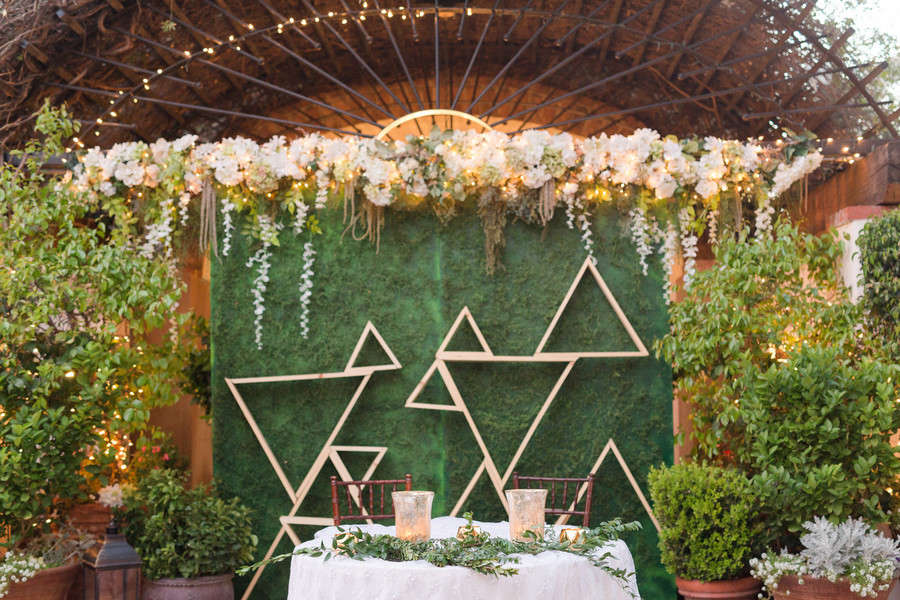
A panel of living moss or preserved grass with wooden geometric triangles layered in front of it, white and cream florals cascading from a draped top edge. The three elements each do a specific job: the grass handles the green, the triangles handle the architecture, the florals handle the softness. It reads as designed rather than assembled because each layer has a clear purpose and they don’t compete. A practical version of this can be rented or DIY’d using artificial grass panels, which hold up through an outdoor reception without wilting.
Twinkle-Light Heart Installation

A heart shape outlined in warm twinkle lights, suspended against a plain white wall behind the ceremony altar. The surrounding room stays deliberately dark so the light sculpture is the only element asking for attention. It’s a backdrop that works because of what’s missing on either side of it — no draping, no florals, no signage, just the shape and the light. For couples working with a bare industrial or loft venue, a light installation like this transforms a blank wall at a fraction of the cost of a floral setup.
See this Washington Warehouse Wedding →
Bare Wood Frame Opening Onto Ocean
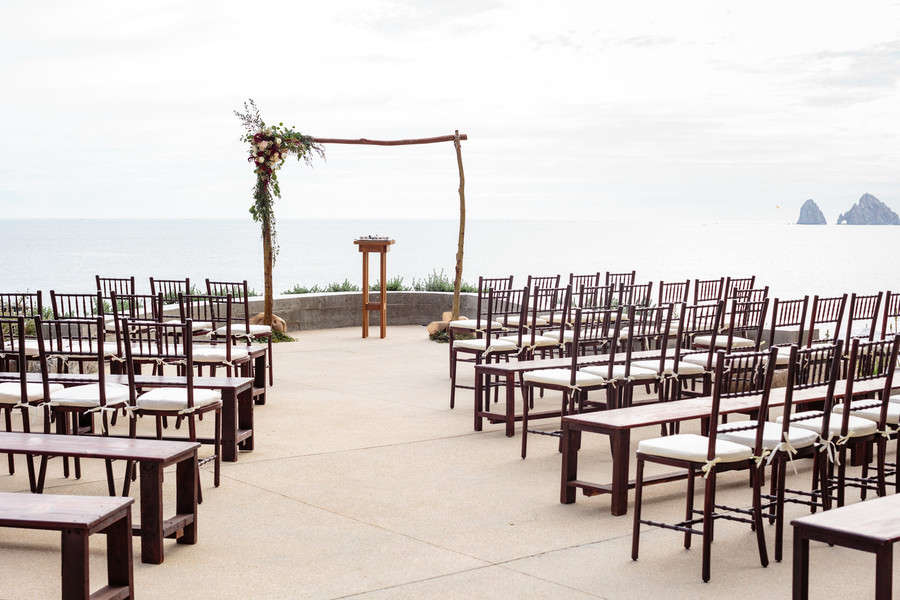
A raw wood arch at The Cape in Cabo San Lucas, standing without flowers or draping at the end of a ceremony aisle that drops straight to the Pacific. The arch marks where the couple will stand and does nothing else — the horizon, the water, the rocks below handle everything. When the view is this strong, additional decoration would only compete with it. This is what it looks like to let the location be the backdrop.
See Qynn and Ngan’s Cabo Wedding →
Two Living Trees With Fabric Draped Between

Two trees already growing at the edge of the property, with a single length of sheer white fabric draped between them to define the ceremony space. Nothing is built here, nothing is installed. The Lake Erie shoreline stretches behind them. This kind of backdrop is the most site-specific thing on this list — it only works because these two trees were already there, at this spacing, in this spot — and that specificity is exactly what makes it look like no one else’s wedding.
See Summer and Will’s Avon Lake Wedding →
Plain Wooden Frame Against Still Water

A square wood-frame arch in a backyard, the lake sitting perfectly still behind it. No florals, no draping — the arch is only a frame, and the water provides everything else. The simplicity works because still water has its own depth and texture: it catches light, reflects the sky, and shifts with the weather. When a backdrop is this responsive to its environment, adding decoration would make it static.
See Kaitlyn and Jeremy’s Backyard Wedding →
Driftwood-Style Frame With Fabric Drape
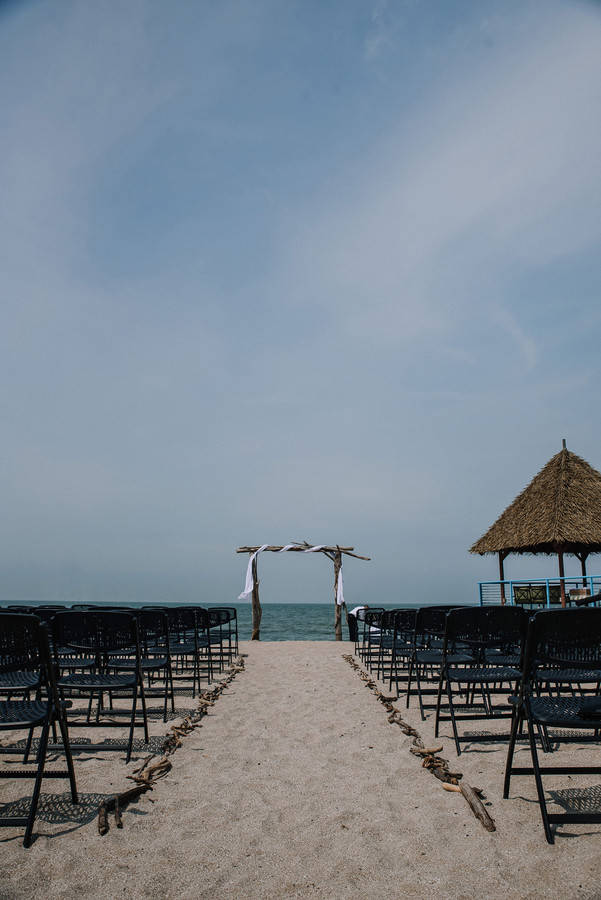
A frame assembled from weathered, rough-cut wood and draped with a length of white fabric, positioned on a beach with Lake Erie behind it. The textured wood against the clean horizon creates a quiet contrast — nothing about the arch is polished, which is exactly right for the setting. Simple beach backdrops made from natural materials tend to age well in photos because there’s nothing dated about wood, white fabric, and open water.
See Kim and Mark’s Port Clinton Wedding →
Living Oak With Cascading White Fabric
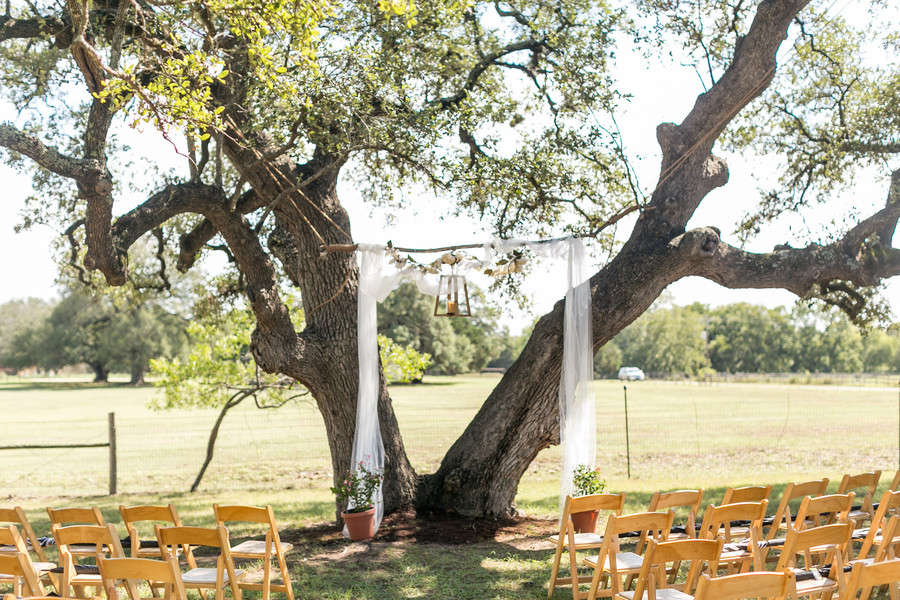
A rangy live oak with sweeping branches, fabric lengths draped from limb to limb to create a natural canopy frame. There is no constructed structure here — the tree itself is the backdrop, and the canyon view opens behind it. This is rare because most venues don’t have a tree this substantial in the right location, which is exactly what makes it unforgettable when it works. One length of fabric and something to drape it from is all it takes when the tree is right.
See Katherine and James’s Texas Ranch Wedding →
Simple Wooden Arch on a Dock

A basic wooden arch on a dock in the Les Cheneaux Islands, with just enough greenery to read as a ceremony space and a motorboat and open water filling the frame behind the couple. The dock becomes part of the composition — the weathered wood underfoot, the boat, the expanse of lake. Setting-specific backdrops like this are impossible to replicate off-site, which is both their limitation and what makes them worth choosing.
See Erin and Ben’s Michigan Wedding →
Teepee-Style Arch Against Mountain Panorama

Wooden poles arranged in a teepee shape, topped with a small cluster of greenery, on a hillside above Queenstown with New Zealand’s Southern Alps and a lake filling the view behind the couple. The geometric simplicity of the teepee form means your eye moves straight through it to the mountains rather than stopping at the structure. A backdrop that tries to compete with a view like this would lose every time — this one knows better.
See Kate and Tom’s Queenstown Wedding →
Dark Wood Arch With One-Sided Floral Corner

A dark wood pergola-style arch with a single cluster of burgundy and cream florals placed at one corner, a desert mountain range in the opposite background. The groom built this himself. One-sided placement is worth noting as a budget strategy: it costs significantly less than a fully wrapped arch, installs faster, and photographs with more visual interest than symmetrical florals because the asymmetry gives the eye somewhere to travel. The mountain backdrop does the heavy lifting; the florals just punctuate it.
See Dominique and Luke’s Tucson Wedding →
Triangle Frame Against a City Skyline

A triangle arch with loose pampas grass and white flowers on a Miami Beach rooftop, with the ocean and city skyline filling the background behind it. The triangle form keeps the structure graphic and clean so the skyline remains readable through it. Rooftop ceremony backdrops work on this principle: the city view is always more interesting than anything you bring in, so the frame just needs to define the ceremony space without blocking what’s behind it.
See Chloe and Ben’s Miami Beach Elopement →
Iron Arch Standing in Lavender Rows
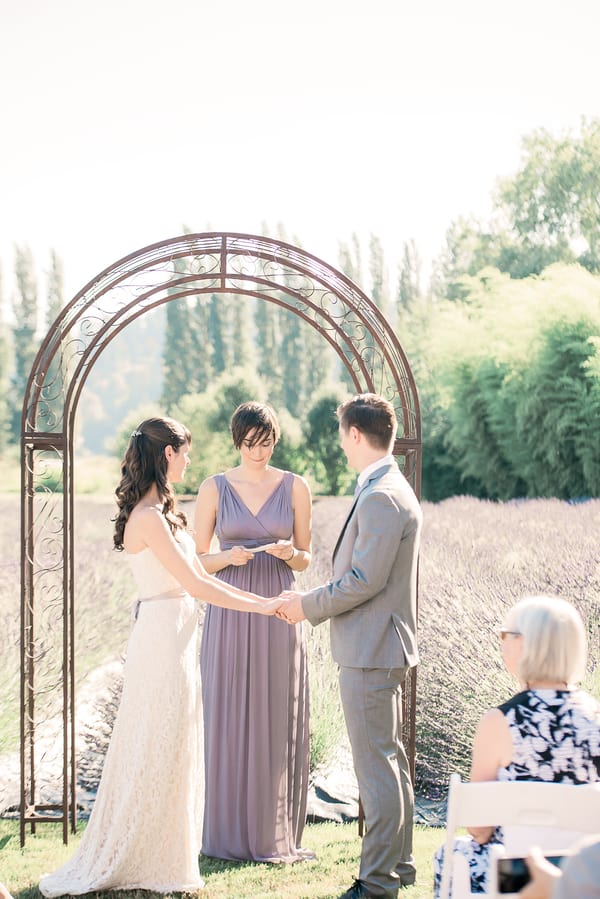
A painted iron arch at a working lavender farm in Woodinville, Washington, with rows of lavender stretching out on all sides behind the couple and officiant. The arch barely needs decoration — its job is the narrowest possible version of the job: mark the spot where the couple will stand. The lavender field handles everything else. Farm and orchard settings are worth considering for exactly this reason: the crop rows create natural depth and pattern that no backdrop installation can replicate.
See Laura and James’s Lavender Farm Wedding →
Bamboo Frame Against Turquoise Water
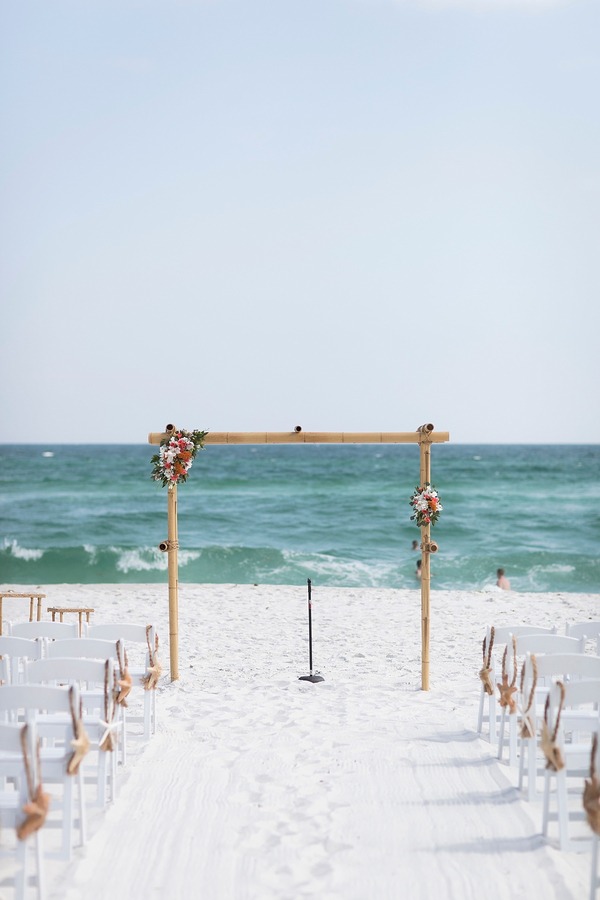
A bamboo rectangular arch with modest flower clusters at the lower corners, standing on white Florida sand with the Gulf’s turquoise water behind it. The natural color of the bamboo almost disappears against the bright beach environment — it’s one of the least intrusive ceremony frames on this list. A small detail worth borrowing: the starfish placed along the aisle chairs tie the backdrop material to the setting so everything feels chosen for the same place.
See Jessica and Heath’s Pensacola Beach Wedding →
Copper Square Frame as Portrait Backdrop

A copper pipe square frame with eucalyptus and foliage across the top, paired with a sheer white curtain backdrop for a bridal portrait session. The warm metallic tone of the copper reads as modern rather than rustic, which makes it a versatile option for indoor ceremonies and styled portrait setups. Copper pipe frames are widely available for rent, travel easily, and work against both light and dark backgrounds — one of the more practical simple backdrop structures available.
See this Classical Music Styled Shoot →
Copper Chuppah With White Fabric Panel
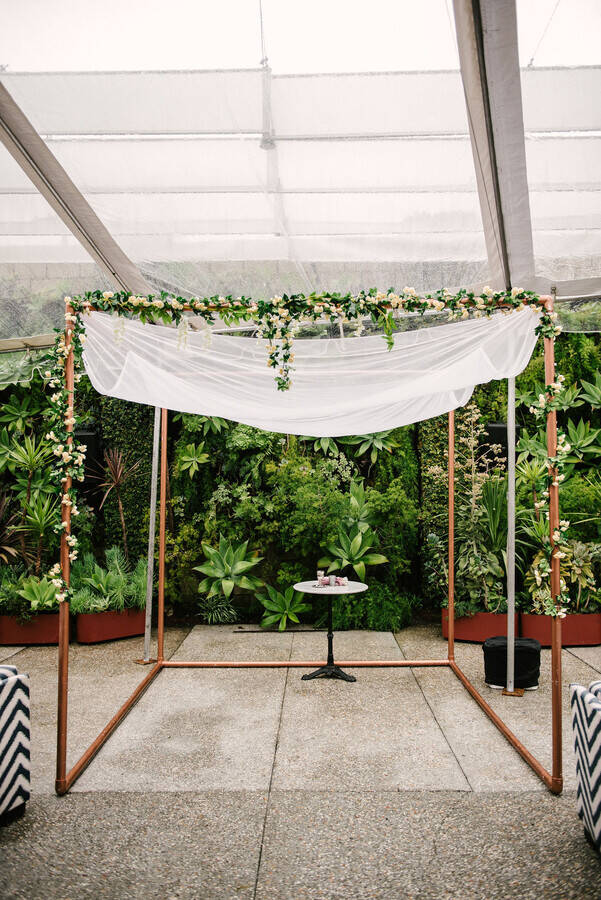
A four-posted copper pipe chuppah with a single panel of white fabric draped over the top and greenery woven through it, a tropical garden visible through the tent behind it. The copper and white combination is cleaner and more modern than a traditional wooden chuppah, and the single fabric panel keeps it from reading as a curtained stage. It works equally well as a ceremony structure and as a portrait backdrop — which is a reasonable thing to look for when you’re investing in an installation.
See Racheli and Adam’s LA Wedding →
Full Circle Frame in Soft Blush Florals
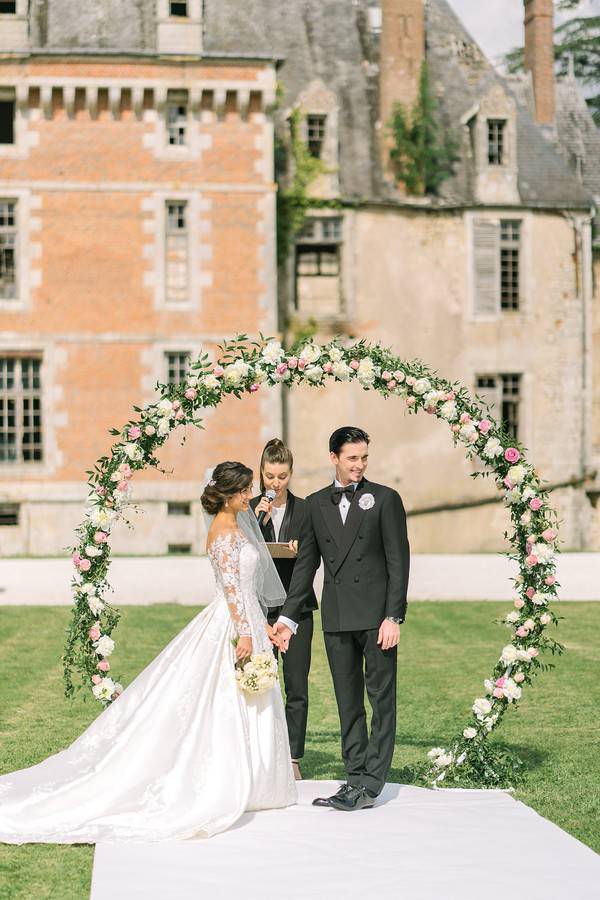
A complete circle frame covered in white and blush florals all the way around the top and sides, the couple standing inside it during the ceremony. It’s more decorated than most entries on this list, but the monochromatic bloom palette — all white and cream — keeps it from feeling heavy or overdressed. Circle arches photograph especially well from a straight-on angle because the geometry is so clean: the round shape creates a perfect natural frame for the couple.
Birch Tree Arch With Autumn Florals

Birch trees bent and shaped into an arch, with autumn wildflowers and foliage woven through them and a lake visible behind the couple. The white bark of the birch provides natural contrast without any paint or treatment — it creates its own light quality in photos. Natural branch arches look most intentional when the surrounding environment echoes their palette, and an autumn lakeside setting does exactly that: the warm tones in the florals repeat in the leaves and the water reflects whatever light is available.
See this Lakeside Bohemian Styled Shoot →
Curly Willow Branch Frame With Hanging Greenery
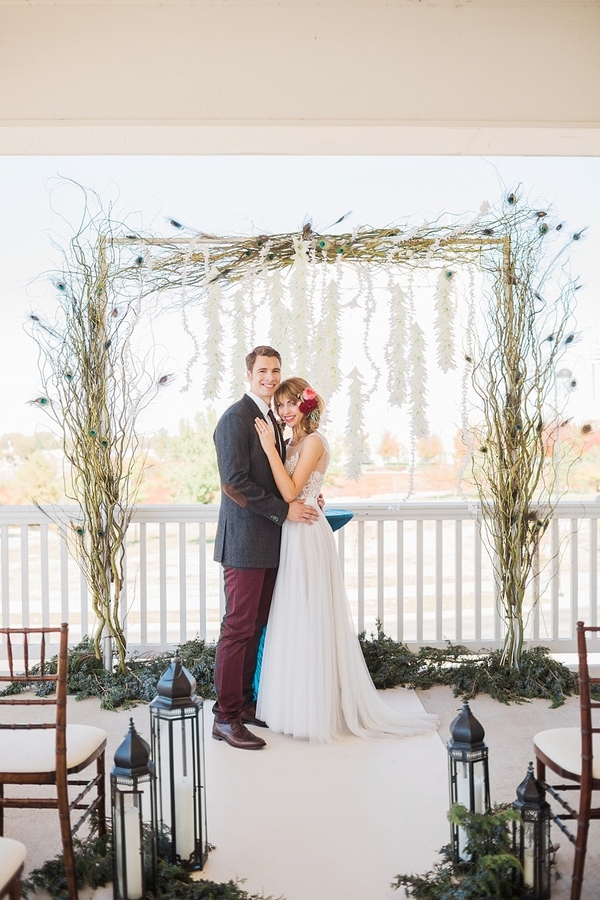
Curly willow branches form a full ceremony frame, with hanging greenery from the crossbar and peacock feathers tucked into the sides. The structure fills the frame behind the couple the way a floral wall does: texture and depth without a single flower arrangement.
See this Pomegranate and Artichoke Wedding Inspiration →
White Painted Frame With Green Garland
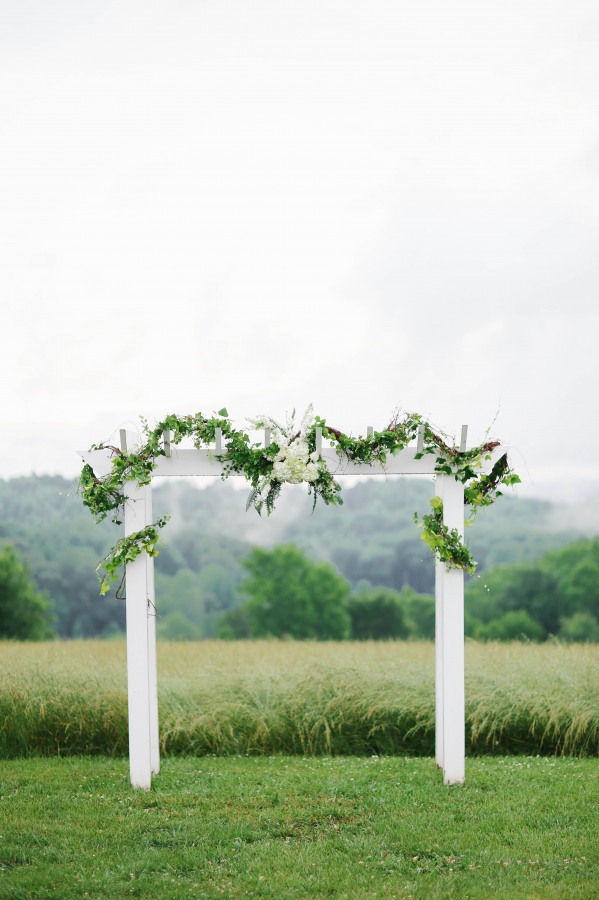
A white-painted wooden arch dressed only in a trailing garland of greenery, standing in an open field with misty hills behind it. White and green is one of the most reliable color combinations for an outdoor ceremony backdrop: it reads as clean and classic in nearly any light — overcast, golden hour, midday — and suits gardens, fields, vineyards, and wooded properties with equal ease. If you want a backdrop that will translate across seasons and settings, this is the base to start from.
See this Southern Rustic Wedding →
Log Frame With Colorful Ribbon Streamers

A log arch with lengths of fabric ribbon in warm tones — terracotta, cream, coral, sage — streaming from the crossbar around the couple. The ribbons catch and move in any outdoor breeze, which makes it one of the more dynamic backdrops on this list. It’s also one of the more DIY-accessible options: you need a frame, fabric cut into strips, and something to tie them with. Worth considering for couples who want a handmade, colorful backdrop without the assembly time and cost of fresh florals.
See this Cooper Spur Wedding →
FAQs
Common questions about simple wedding backdrops, from what they include to how to make them work in photos.
What’s the difference between a wedding arch and a wedding backdrop?
An arch is a specific structure type — a frame or gate shape that marks the ceremony space. A backdrop is any element placed behind the couple to define the visual space behind them. All arches function as backdrops, but not all backdrops are arches. A floral wall, a panel of draped linen, a string light installation, and even a strong natural feature like a row of lavender or an ocean horizon can all serve as a backdrop without any arch structure at all. The terms are often used interchangeably because in practice, most couples are looking for the same thing: something that makes the space behind them intentional and photogenic.
Do I need a backdrop for my wedding ceremony?
Not necessarily. When the ceremony venue already has a strong natural backdrop — an ocean, a mountain range, rows of lavender, a château — the view is doing the work and an installed structure is optional. The case for adding one is mostly practical and photographic: it gives the photographer a defined foreground element, creates depth in the images, helps guests understand where to look, and gives the couple something to stand in front of for portraits before and after the ceremony. For venues without a naturally strong backdrop — a blank indoor wall, an unremarkable backyard fence, a flat grass field — a simple constructed backdrop does real and visible work.
What’s the simplest wedding backdrop you can actually DIY?
A fabric draping backdrop requires no construction skills: you need a freestanding frame or a horizontal rod, lengths of sheer fabric, and a few clamps. String light installations are equally accessible — a heart or geometric shape made from twinkle lights needs only wire, a power source, and a wall or ceiling to hang from. Ribbon streamers from a log or wooden frame are even more basic: cut fabric into strips and tie them to the crossbar. The most labor-intensive DIY backdrops are fresh floral walls, which are assembly-intensive and time-sensitive, and natural branch or tree arches, which depend on finding the right materials on-site.
How do I make a simple backdrop look finished in photos?
Finished doesn’t mean fully decorated — it means intentional. A few approaches that consistently work: match the backdrop material to the setting (rough wood and fabric in a forest, bamboo or driftwood at the beach, copper pipe for an industrial venue); place florals on one side only rather than trying to cover the whole structure; use a single fabric color and a single material rather than mixing; and leave visible space between the backdrop and the surrounding environment so the frame reads as a distinct object rather than blending into the background. The question to ask is not “what should I add?” It’s whether anything you’ve already added is competing with the couple or the view behind them.
What backdrop works best when the outdoor setting is already beautiful?
When the scenery is the story — mountains, ocean, lavender fields, a vineyard at harvest — the backdrop’s job is to disappear as much as possible. Bare or minimally decorated wooden frames let the view pass through them without interruption. Two trees draped with a single length of fabric use what’s already there without adding anything that could compete. A bamboo arch on a beach blends with the environment rather than standing out from it. The more dramatic the natural backdrop, the simpler the constructed element should be. Overdecorating in front of a great view is one of the most common mistakes in ceremony design — the decoration draws the eye toward itself and away from the landscape that made you choose the venue in the first place.