There is a traditional answer, and there are many good reasons to change it. This guide walks you through the classic wedding speech order, when in the evening the speeches work, how long each one should be, and how to adapt the lineup to your own families. At the end you will find three sample run-of-show plans and a short message you can send to your speakers.
The Traditional Wedding Speech Order
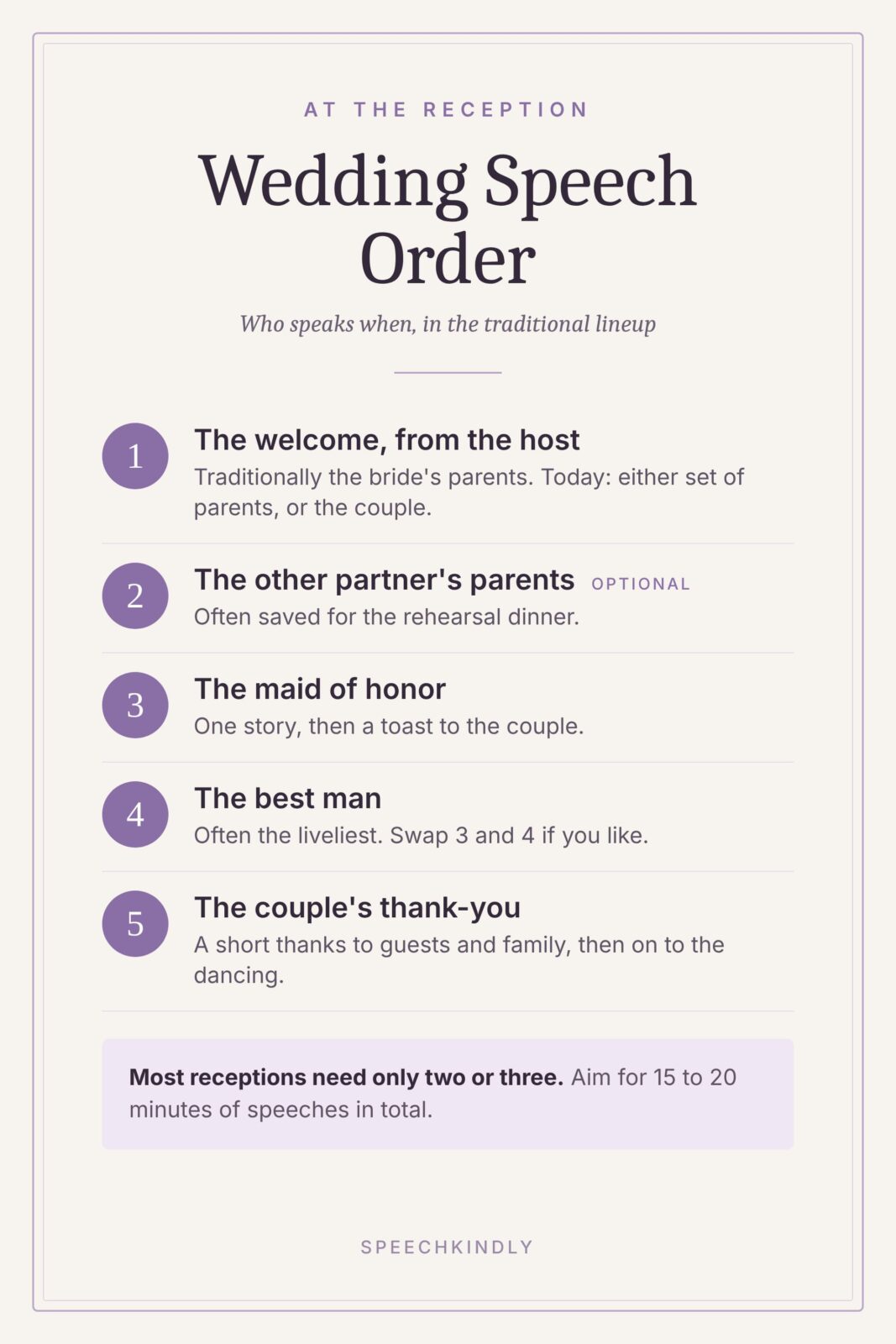
In a classic American reception, the speeches go roughly like this:
- The welcome, from the host. Traditionally this is the father of the bride, or both of her parents, because they hosted the wedding. Today the host can be either set of parents, both sets together, or the couple themselves. The welcome is short. It thanks everyone for coming and says something warm about the newlyweds.
- The other partner’s parents (optional). If both families want to speak, the second set of parents follows the welcome. Many families save this one for the rehearsal dinner.
- The maid of honor.
- The best man. In many weddings the best man goes last among the wedding party, because his speech is often the liveliest and it leads into the toast. Some couples swap the maid of honor and the best man. Either order is fine.
- The couple’s thank-you. One or both of you close with a brief thank-you to your guests, your families and your wedding party. Then the party starts.
That is the full lineup. Very few weddings need all five. Two or three speeches are plenty for most receptions, and your guests will thank you for it.
When Should The Speeches Happen?
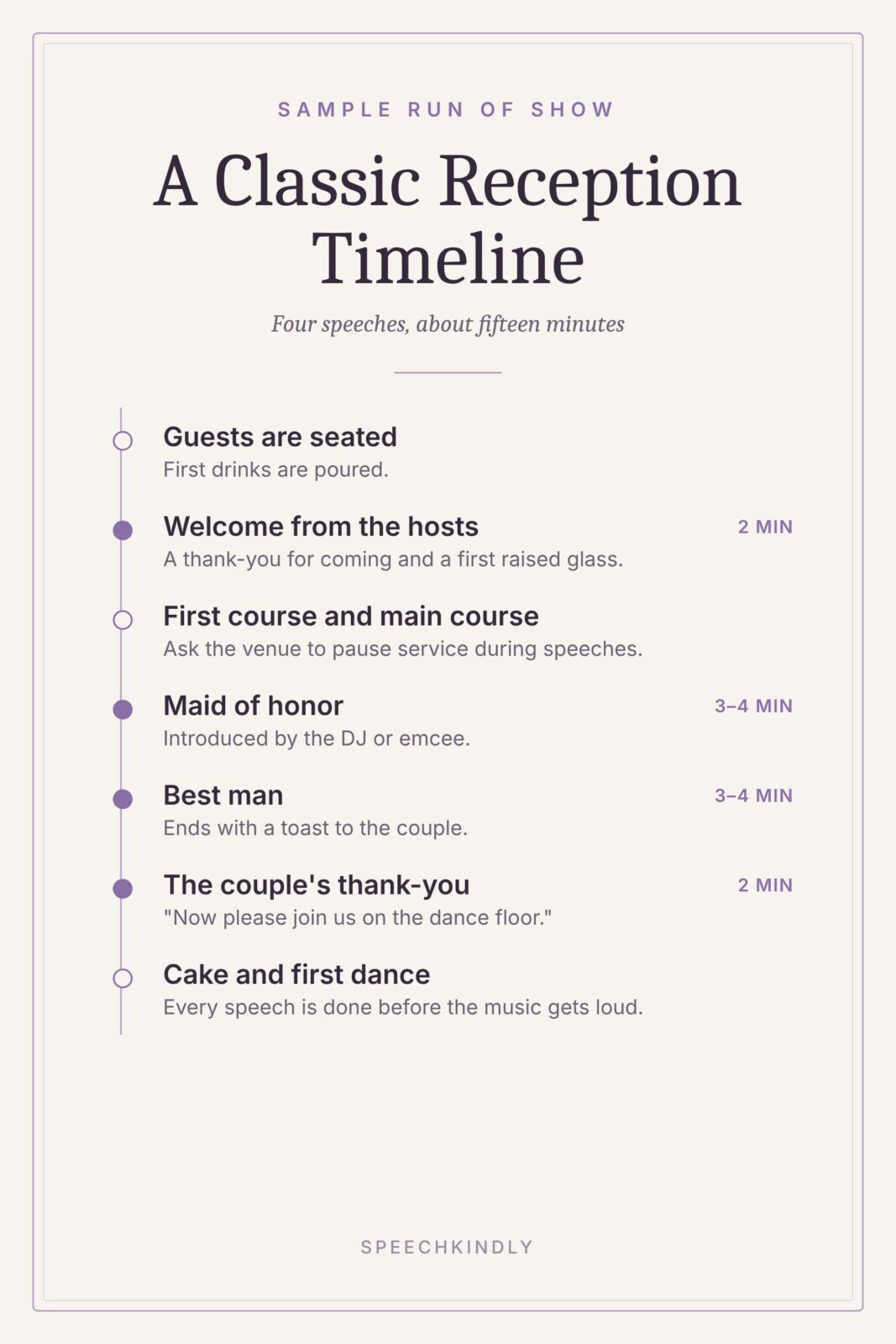
The order matters less than the timing. Here are the three options that work, with the trade-offs for each.
Right after everyone sits down. Guests are fresh, the room is quiet, and nervous speakers get their part over with before dinner. The risk is hungry guests, so keep this slot for one or two short speeches.
Between courses. This is the most popular choice. A welcome before the first course, then the maid of honor and best man after the main course, keeps the evening moving and gives the kitchen natural pauses. Tell your caterer the plan, so plates are not being cleared while someone is at the microphone.
Just before the cake or the first dance. This works well for the couple’s thank-you, because it turns into a natural handoff: “Thank you all for being here. Now please join us on the dance floor.”
One timing rule of thumb is worth following. Finish every speech before the dancing starts in earnest. Once the music is loud and people are out of their seats, it is hard to bring the room back.
How Long Should Each Speech Be?
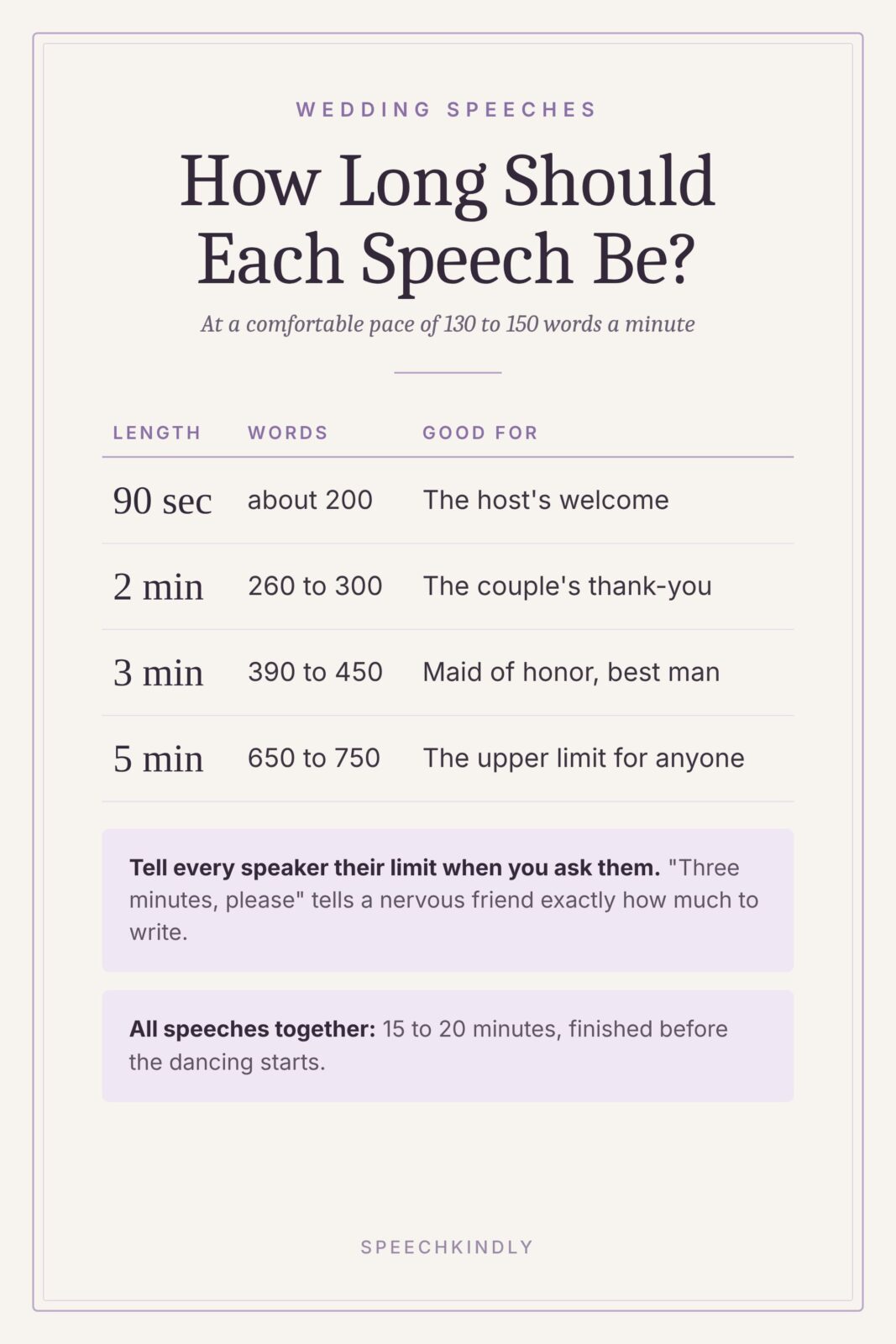
A good target is two to five minutes per speaker, and fifteen to twenty minutes in total. At a comfortable speaking pace of about 130 to 150 words a minute, that means:
- 2 minutes: about 260 to 300 words
- 3 minutes: about 390 to 450 words
- 5 minutes: about 650 to 750 words
A welcome from the host can be even shorter. Ninety seconds is enough to say thank you and raise a glass.
Give every speaker a clear limit when you ask them, not the week before. “Three minutes, please” is a kindness. It tells a nervous friend exactly how much to write, and it protects your schedule from the one speech that runs to twelve minutes.
Modern Variations on the Order
The traditional order assumes a bride, a groom, her father as host, and a best man and maid of honor. Plenty of weddings look different, and the order bends easily.
Both partners want to speak. Lovely. You can speak together, taking turns by paragraph, or one after the other. Many brides now give their own speech, and there is no reason the thank-you has to come from only one of you.
Two brides or two grooms. Drop the labels and keep the structure: a welcome from whoever is hosting, one or two speeches from the people who know you best, and a thank-you from the two of you. Each partner can choose one speaker, so both sides of the room are represented.
A man of honor or a best woman. The role names change and the slot stays the same.
The couple is hosting. If you paid for and planned the wedding yourselves, you can give the welcome. Then you may want to keep your closing thank-you very short, or fold both into one speech at the start.
Divorced or blended families. Think about who would feel honored and who would feel pressured. A parent and a stepparent can each say a few words, a parent can speak alone, or the parents can skip the microphone and be thanked warmly in your own speech. There is no order that solves a family dynamic, so choose the lineup that lets everyone relax.
No wedding party. Ask a sibling or a close friend each. One speaker per partner is a tidy, balanced lineup.
A parent who has died. Some couples ask an aunt, uncle, grandparent or older sibling to give the welcome. Others give the welcome themselves and mention the parent by name. Both are gentle ways to keep that person in the room.
Use The Rehearsal Dinner
If more people want to speak than your reception has room for, the rehearsal dinner is the answer. It is smaller, more relaxed, and traditionally hosted by the groom’s parents, so it is the natural place for their welcome. It is also the right place for the college roommate with a long story, the grandparent who wants to say a few words, and anyone who might be emotional in front of 150 people.
A simple rule: formal speeches at the reception, open floor at the rehearsal dinner.
Three Sample Run-of-Show Plans

The classic (four speeches, about 15 minutes)
- Guests are seated, first drinks are poured
- Welcome from the bride’s parents (2 minutes)
- First course
- Main course is cleared
- Maid of honor (3 to 4 minutes)
- Best man (3 to 4 minutes)
- The couple’s thank-you (2 minutes), leading into the cake or first dance
The short one (two speeches, about 7 minutes)
- Guests are seated
- Welcome and thank-you from the couple (2 minutes)
- Dinner
- One speech from a sibling or best friend, ending with the toast (4 to 5 minutes)
- First dance
The split (reception stays light)
- Rehearsal dinner: welcome from the hosts, then an open floor for parents, grandparents and friends
- Reception: maid of honor and best man after dinner (3 minutes each), then the couple’s thank-you
Help Your Speakers Do Well
The order on paper only works if the people in it are ready. A few small things make a big difference.
- Tell each speaker their slot and their limit. “You are second, after my dad, and you have three minutes.”
- Share who else is speaking. Speakers can then check with each other, so two people do not tell the same story about the camping trip.
- Mention the audience. If children and grandparents will be in the room, say so. It gently steers people away from stories about exes and long nights out.
- Give the plan to your DJ, band leader or emcee. They introduce each speaker, hand over the microphone and keep the gaps short.
- Check the microphone before guests arrive, and ask the venue to pause service during speeches.
- Ask each speaker to end with a toast. It gives every speech a clear finish and tells the room when to raise a glass.
If one of your speakers is stuck on a blank page, there are tools that can help with a first draft. Speechkindly, for example, drafts a wedding toast with AI from the speaker’s own stories about the couple, in two, three or five minutes, and the speaker can edit it from there. Whatever they use, a good speech comes from one real story, told simply.
A Message You Can Send to Your Speakers
Copy this, change the details, and send it a few weeks ahead:
“We would love for you to say a few words at our reception. You will be speaking after dinner, right after [name], and before [name]. Please keep it to about three minutes, which is around 400 words. There will be kids and grandparents in the room. If you can, end with a toast so everyone knows when to raise a glass. The DJ will introduce you. Thank you for doing this. It means a lot to us.”
Frequently Asked Questions
Who speaks first at a wedding reception? Traditionally, the host gives a short welcome first. That used to mean the father of the bride. Today it can be either partner’s parents or the couple.
Does the best man or the maid of honor go first? Either. The common order is maid of honor, then best man, but many couples reverse it. Put the more confident speaker last.
Should the bride give a speech? If she would like to, yes. A bride’s speech is often a thank-you to guests and family, a few words to her new spouse, and a toast. It can stand alone or be shared with her partner.
How many speeches is too many? More than four or five at the reception usually feels long. If the total goes past twenty minutes, move some speakers to the rehearsal dinner.
Do we need speeches at all? No. A single welcome toast from the two of you is a complete and gracious choice.
The Short Version
Start with a welcome from the host, follow with one or two people who know you best, and finish with your own thank-you. Keep each speech under five minutes, finish before the dancing, and tell every speaker their slot and their limit. The order is yours to set. What your guests will remember is that the speeches were warm, short and about the two of you.